
Ubud · Nature
Tibumana Waterfall: Tickets, Swimming and the Walk Down
A single curtain of water falling into a calm, swimmable pool in Bangli, 30 to 40 minutes east of Ubud.
By The Bali Guideline Editorial TeamUpdated 9 November 2026
Overview
Tibumana Waterfall, before you go.
Tibumana is a single column of water, about 20 meters high, that pours into a round swimming pool in Apuan village, Bangli, about 15 km and 30 to 40 minutes by road east of central Ubud. A 10- to 15-minute jungle walk leads down to it. Go for an easy, calm swim on a dry morning; skip it right after heavy rain, when the pool turns brown.
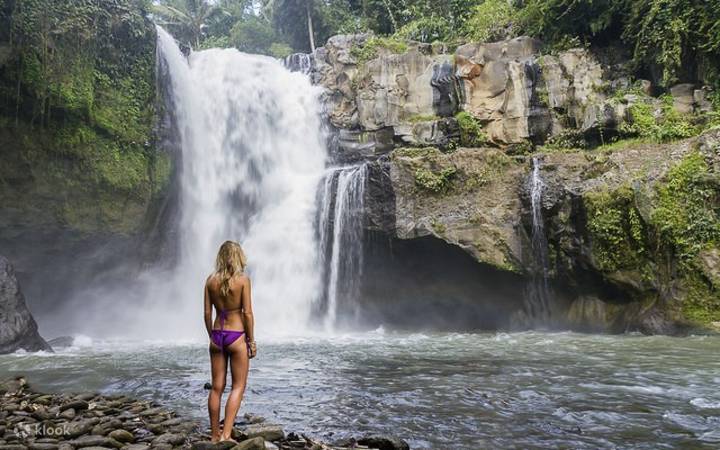
Tibumana is not in Ubud. It lies in Apuan, a farming village in the Susut district of Bangli regency, about 15 km by road east of Ubud Palace. It is grouped with Ubud because that is where most visitors sleep and find a driver. The fall itself is simple: one narrow column of water, about 20 meters high by local press accounts, slides off a cliff hung with vines and ferns into a round pool. In the rainy months a second, thinner fall runs a short way downstream, and below the pool the water narrows back into a small river.
The appeal is the swim, and how little effort it takes. A mostly concrete path with handrails runs about 500 meters down through bamboo and jungle, over two bamboo bridges, to a pebble beach at the edge of the pool. The bottom shelves gently, the water is about waist deep in most places, and a marked zone shows where you may swim. Staff on the pool edge wave people back from the base of the fall, where the force of the water and an occasional falling stone are a real risk.
To Apuan, the pool is more than a swimming hole. Villagers regard its center as a niskala bath, a bathing place for the unseen world, and the Visit Bali listing asks swimmers to keep to the edges out of respect. You will see offerings on the rocks. Behind the fall is a narrow, pitch-dark cave that local lore says leads all the way to Goa Raja at Besakih, the mother temple on Mount Agung. Visitors do not go in.
Tibumana was still a quiet local spot in the mid-2010s. In 2016 NOW! Bali described an IDR 10,000 contribution paid at a shack in the parking lot. Since 2018, the customary village of Apuan has managed the site, with daily operations run by Dharma Abadi, the village-owned enterprise, according to studies from Warmadewa University. A village decree changed the rates in July 2024, and guides updated in 2026 give about IDR 25,000. Toilets, changing rooms and food stalls now line the path.
The catches are few but real. After heavy rain the water turns brown, the steps get slick, and the cliffs around the gorge are prone to small landslides. From late morning, tour vans doing the Kanto Lampo and Tukad Cepung loop arrive. And on most days the pool is pale green, not the bright turquoise of many online photos. Come early on a dry morning and it is the easiest waterfall swim near Ubud.
- Opening hours
- Daily about 7 AM–6 PM (checked Nov 2026)
- Ticket
- About IDR 25,000 per person, cash only (checked Nov 2026)
- Time needed
- 1–2 hours, including 10–15 minutes each way on foot
- Best time
- 7–9 AM on a dry day; dry season (April–October) for clear water
- Dress code
- Swimwear under your clothes; shoes or sandals with grip
- Location
- Apuan, Susut, Bangli, about 15 km by road from central Ubud
Today at Tibumana Waterfall
- Daylight
- to
- Hours of light
- 12 hr 28 min of light
Checking the weather in Ubud…
Times for this spot, in Bali time (WITA).
Jl. Desa Apuan, Banjar Bangun Lemah Kawan, Apuan, Susut, Bangli Regency, Bali 80661, Indonesia
Open in Google MapsWhat to See
What to see at Tibumana Waterfall.
- 01
The main fall and its pool
A single narrow stream drops about 20 meters from a cliff draped in vines, ferns and moss, into a round pool walled in on three sides. It is a fall you look up at from the water rather than from a viewing deck. The pool drains downstream into a shallow river over smooth stones, and a dry platform with seating sits beside it for anyone who would rather watch than swim.
- 02
Swimming in the marked zone
Swimming is allowed in a marked area of the pool, and a sign at the water shows where it starts and stops. You wade in from a pebble beach, and the water is about waist deep in most places. Do not swim to the base of the fall or stand under it. Staff on duty wave flags at anyone who drifts too close, because the falling water hits harder than it looks and stones can come over the edge.
- 03
The jungle path and bamboo bridges
The walk in is short and shaded. From the ticket booth a concrete path with handrails winds about 500 meters down through bamboo, palms and farmland, crosses two bamboo bridges over a stream, then turns left at a small Tibumana sign. Walk past that sign and you head away from the fall. Allow 10 to 15 minutes down and a little more for the climb back, which is steeper than it feels on the way in.
- 04
The seasonal second fall
During and just after the rainy season a smaller fall runs a short way downstream from the main one, and OpenStreetMap marks it as Tibumana Small Waterfall. Visitors found it flowing in May 2024 and dry again by September of that year. If it is running, it makes a quieter spot to sit while swimmers fill the main pool. In the dry season, do not expect it.
- 05
The cave and the offerings
Behind the curtain is a narrow, black cave. Apuan lore holds that it runs underground all the way to Goa Raja, the cave shrine at Besakih, and visitors do not enter it. Villagers also treat the center of the pool as a niskala bath, a sacred bathing place, so keep to the edges and step around the small canang offerings left on the rocks by the water.
- 06
Two falls in one morning
Kanto Lampo, the stepped fall in Beng, is only about 5 km away by road, a 10- to 15-minute drive. Start there when it opens at 6:30 AM, before the photo line forms, then come to Tibumana for the swim. Kanto Lampo charges its own entry fee. Add Tukad Cepung, 30 to 40 minutes north in Tembuku, if the sky is clear and you want its morning light beams.
Seasons
Best time to visit Tibumana Waterfall.
Arrive at the 7 AM opening to have the pool to yourself; between about 8 and 9 AM the sun starts to light the trees above the fall. From about 11 AM the tour vans arrive, and the hours around lunch are the busiest. Early afternoon is often manageable, but you will share the pool.
The fall runs all year. April to October, the dry season, gives the clearest water and the driest steps. From November to March the flow is stronger and the second fall appears, but rain upstream turns the pool brown and the path muddy, and the cliffs around the gorge can shed rocks and soil. Go in the morning, before afternoon storms build, and skip it during or right after heavy rain.
Religious days can change the hours, so check before you drive out on Galungan (13 January 2027) and Kuningan (23 January 2027). On Nyepi, 8 March 2027, the whole island stays home for 24 hours and nothing opens.
Coming between November and March? Read our Bali rainy season guide →
Getting There
How to get to Tibumana Waterfall.
| From | Time | How |
|---|---|---|
| Central Ubud | 30–40 min | About 15 km by car or scooter, east past Goa Gajah and through Bedulu, then north into Apuan on village roads. Hire a driver for a half day, or ride a scooter if you are confident on narrow lanes. |
| Kanto Lampo Waterfall | 10–15 min | About 5 km by road north from Beng. The two falls are usually visited together. |
| Sanur | 50–70 min | About 33 km by car, north through Batubulan and Sukawati, then east toward Gianyar and up to Apuan. Leave by 7 AM to beat the traffic and the tour vans. |
| Seminyak or Kuta | 1.25–2 hours | About 44 km by car with a driver. Too far for the fall alone; pair it with Kanto Lampo, Tukad Cepung or a day in Ubud. |
| Canggu | 1.25–2 hours | About 44 km by car across Denpasar. Morning traffic sets the time, so leave early. |
| Bali airport (DPS) | 1–1.75 hours | About 46 km by car. Not a stop for arrival day; plan it from Ubud or Sanur instead. |
| Uluwatu or Nusa Dua | 1.5–2.5 hours | About 52–64 km by car. Only worth it as part of a full waterfall day or on the way to a night in Ubud. |
Getting around Tibumana Waterfall
The lane into Apuan ends at the ticket booth and parking area, beside a village temple. Accounts of parking differ: a 2026 guide found it free, while others list IDR 5,000 for a scooter and IDR 10,000 for a car. Pay the entrance fee in cash at the booth; there is no card payment and no ATM at the site. The last stretch of road through the village is narrow, and older guides warn that it gets slippery in the rainy season.
From the booth it is about 500 meters on foot to the pool: a mostly concrete path with handrails, some stairs and pebble sections, and two bamboo bridges. It takes 10 to 15 minutes down and a little longer back up. Toilets and changing rooms sit along the path and near the pool. Some recent visitors report lockers for about IDR 5,000 and others found none, so leave bags and valuables in the car. The path is not wheelchair accessible.
Most people come with a driver hired from Ubud for a half or full day, usually with Kanto Lampo and Tukad Cepung on the same loop. Grab and Gojek can drop you off, but taxis do not wait in Apuan and rides back are hard to find, so keep your driver or arrange the return before you go. On a scooter, carry an international driving permit and a dry bag for your phone.
Tickets & Tours
Tibumana Waterfall tours on Klook.
You can visit on your own with the details above. If you would rather have the driver, guide or entry sorted, these Klook tours include Tibumana Waterfall. Prices, pick-up areas and what is included vary, so check the listing before you book.
 Day tripBali Waterfall Private Full-Day Tour with TransfersSee it on Klook (opens in a new tab)
 Day tripUbud Highlights Private Day TourSee it on Klook (opens in a new tab)
 Day tripExplore Ubud: Rice Terrace, Temple & Waterfalls Private TourSee it on Klook (opens in a new tab)
Affiliate links: we may earn a commission if you book, at no extra cost to you. Affiliate disclosure
Know Before You Go
Tibumana Waterfall tips that save time and trouble.
- 01Bring cash in small bills: about IDR 25,000 per person for the ticket, plus parking and a coconut on the way back up.
- 02Wear swimwear under your clothes to save time in the changing rooms along the path.
- 03Wear shoes or sport sandals with grip. The steps, bridges and rocks by the pool are slick when wet.
- 04Swim only inside the marked zone, and never stand directly under the fall.
- 05Keep to the edges of the pool and step around the offerings on the rocks; villagers treat the center as sacred.
- 06Check the weather before you leave Ubud. If it rained hard overnight, the pool will be brown; go another day.
- 07Pack a towel, a dry change of clothes and a dry bag for your phone.
- 08Turn left at the small Tibumana sign on the path; keep going straight and you walk away from the fall.
- 09Agree on a pickup with your driver. Taxis do not wait in Apuan, and app rides out are hard to find.
FAQ
Tibumana Waterfall questions, answered.
How much is the Tibumana Waterfall entrance fee?
About IDR 25,000 per person, cash only (checked Nov 2026). Guides updated in 2026 mostly give that figure, though one lists about IDR 20,000. A village decree changed the rates in July 2024; it was IDR 10,000 in 2016 and IDR 15,000 around 2019. Parking is free or about IDR 5,000 to 10,000, depending on the account.
What are Tibumana Waterfall’s opening hours?
Daily from about 7 AM to 6 PM (checked Nov 2026), according to most recent guides; detikBali gave 6 AM to 6 PM in 2023. Come at opening for the quietest pool. Hours can change on major religious days, and on Nyepi the whole island shuts down for 24 hours.
Can you swim at Tibumana Waterfall?
Yes, inside a marked zone of the pool. You wade in from a pebble beach, and the water is about waist deep in most places. Swimming to the base of the fall or standing under it is not allowed, and staff on the edge wave back anyone who gets too close. Locals also ask swimmers to keep to the edges, because the center of the pool is considered sacred.
Is Tibumana Waterfall worth it?
Yes, if you want an easy swim after a short jungle walk. It is smaller and less dramatic than Tegenungan or Tukad Cepung, but the walk is gentle, the pool is calm, and it sees fewer people than Kanto Lampo. It is not worth the trip right after heavy rain, when the water turns brown.
How do I get to Tibumana Waterfall from Ubud?
By car or scooter, about 15 km east past Goa Gajah and through Bedulu, then north into Apuan village, a drive of 30 to 40 minutes. There is no public transport. Most visitors hire a driver for a half day and add Kanto Lampo, because taxis do not wait at the site and app rides back are hard to find.
How long is the walk to Tibumana, and is it hard?
It is easy. From the ticket booth it is about 500 meters and 10 to 15 minutes down a mostly concrete path with handrails, some stairs and two bamboo bridges. The climb back takes a little longer and feels steeper in the heat. It is fine for most children with an adult close by, but it is not wheelchair accessible.
Where is Tibumana Waterfall, and is it in Ubud?
It is in Apuan village, Susut district, Bangli regency, east of Ubud rather than in Ubud itself. The ticket booth sits at the end of the village lane, about 15 km by road from Ubud Palace. It is grouped with Ubud because most visitors stay there and see it as a morning trip with a driver.
When is the best time to visit Tibumana?
Between 7 and 9 AM on a dry day. You get the pool almost to yourself, and the morning sun starts to light the trees above the fall. Tour groups arrive from about 11 AM. April to October gives the clearest water; in the wet season the flow is stronger, a second fall appears and the pool often turns brown after rain.
Is Tibumana safe in the rainy season?
In settled weather, yes, with care. Rain upstream raises and muddies the river, the steps and bamboo bridges get slick, and the cliffs around the gorge are prone to small landslides. Go in the morning, skip it during or right after heavy rain, and stay out of the water if it is brown or rising.
Tibumana or Tegenungan: which is better?
Tibumana for a quiet swim, Tegenungan for size. Tegenungan is the bigger, louder fall, closer to Ubud, with a long staircase and a built-up rim. Tibumana is smaller and more natural, with a shorter, gentler walk and a calm pool. If you have a morning, pair Tibumana with Kanto Lampo, 10 to 15 minutes away.
What should I bring to Tibumana Waterfall?
Cash in small bills for the ticket and parking, swimwear worn under your clothes, a towel, shoes or sandals with grip, water and a dry bag for your phone. Lockers are not always available, so leave valuables in the car. It is not a temple, so you do not need a sarong.
Nearby
Where to go after Tibumana Waterfall.
Places close by that fit into the same trip, with realistic travel times.
10–15 min by car (5 km)
Kanto Lampo Waterfall
A 15-meter fall that fans over stepped rock in Beng; open from 6:30 AM, so go first, before its photo line forms.
30–40 min by car (18 km)
Tukad Cepung Waterfall
A fall inside a rock chamber in Tembuku, where sunny mornings from about 9 to 11 AM bring light beams through the spray.
Visitor guide20–30 min by car (11 km)
Goa Gajah
The 11th-century Elephant Cave in Bedulu, right on the road back to Ubud.
Visitor guide30–40 min by car (15 km)
Tegenungan Waterfall
The big, powerful fall on the Petanu River, if you want size after Tibumana’s quiet pool.
Visitor guide25–35 min by car (15 km)
Penglipuran Village
A Bangli village of matching family compounds on a mountain-to-sea axis, with a bamboo forest its residents protect.
30–40 min by car (16 km)
Tirta Empul
The spring temple in Tampaksiring where Balinese families bathe in the melukat purification ritual.
Visitor guide
More in Ubud
Plan the rest of your time in Ubud.
Area guide
Ubud travel guide
Read the guide
Nature
Sacred Monkey Forest Sanctuary
Visitor guide
Temple
Tirta Empul
Visitor guide
Viewpoint
Tegallalang Rice Terrace
Visitor guide
Temple
Goa Gajah (Elephant Cave)
Visitor guide
Nature
Campuhan Ridge Walk
Visitor guide
Nature
Tegenungan Waterfall
Visitor guide
Culture
Ubud Palace (Puri Saren Agung)
Visitor guide
Temple
Gunung Kawi Tampaksiring
Visitor guide
Nature
Tukad Cepung Waterfall
Visitor guide
Family
Bali Bird Park
Visitor guide
Temple
Saraswati Temple (Pura Taman Saraswati), Ubud
Visitor guide
Market & Shopping
Ubud Art Market (Pasar Seni Ubud)
Visitor guide
Nature
Kanto Lampo Waterfall
Visitor guide
Family
Bali Zoo
Visitor guide
Culture
ARMA Museum (Agung Rai Museum of Art)
Visitor guide



How we researched this
Sources and fact checks.
Prices, opening hours, show times and travel times in this Tibumana Waterfall guide were checked against official sites, government tourism pages and recent reporting on 9 November 2026. Where sources disagreed, we give the official figure and say so. Rankings are our editorial judgment, set out in our editorial policy.
We re-check the guide at least every three months and whenever we hear about a change. Spotted something out of date? Tell us.
Show all 18 sources ↓Hide sources ↑
- detik.com/bali/wisata/d-7036323/keindahan-alam-air-terjun…
- visitbali.id/property/the-beauty-of-tibumana-waterfall
- ejournal.warmadewa.ac.id/index.php/csjl/article/view/10148
- ejournal.warmadewa.ac.id/index.php/csjl/article/view/5494
- ejournal.warmadewa.ac.id/index.php/kertawicaksana/article/view/4441
- indonesia.travel/au-en/destination/bali-nusa-tenggara/bali/air-t…
- nowbali.co.id/searching-solitude-tibumana-waterfall
- baliholidaysecrets.com/tibumana-waterfall
- meganstarr.com/tibumana-waterfall-bali
- eternalarrival.com
- bobobox.com/blog/en/tibumana-waterfall
- jonnymelon.com/tibumana-waterfall
- thecommonwanderer.com/blog/tibumana-waterfall-bali-guide
- balibuddies.com/tibumana-waterfall
- world-of-waterfalls.com/waterfalls/asia-tibumana-waterfall
- openstreetmap.org/node/4858759616
- map.project-osrm.org
- thebaliguideline.com/blog/incredible-places-to-visit-in-ubud