
Ubud · Temple
Goa Gajah (Elephant Cave): A Visitor’s Guide
An 11th-century cave, a demon-face doorway and a quiet path down to the Petanu River.
By The Bali Guideline Editorial TeamUpdated 14 October 2026
Overview
Goa Gajah, before you go.
Goa Gajah is a rock-cut Hindu sanctuary from around the 11th century in Bedulu, 5 km south-east of central Ubud, entered through a doorway carved as a gaping demon face. The cave itself takes minutes; the old bathing pools and the steep path down to the river make the visit. It is worth an hour if you are staying in Ubud, not a special trip from the coast.
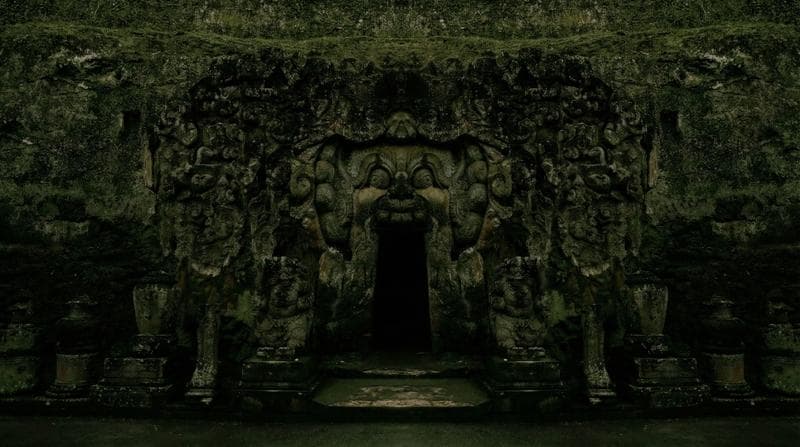
Goa Gajah is a sanctuary cut into the rock above the Petanu River, probably in the 11th century, when Bali was ruled by its own kings. The face around the doorway, with bulging eyes and a mouth that forms the entrance, was meant to frighten away evil spirits, and Balinese folklore says the giant Kebo Iwa carved the whole cave with his fingernail. The site is mentioned in the Javanese court poem Nagarakretagama, written in 1365. It mixes two religions: inside the cave are a Ganesha and the lingam and yoni of Shiva, while down by the river lie carvings of Buddhist stupas.
Dutch archaeologists rediscovered the cave in 1923, and the bathing pools in front of it, with carved female figures holding water pitchers, stayed buried until excavations began in 1954. Indonesia put the site on UNESCO’s tentative list for World Heritage status in October 1995, but it was withdrawn in 2015 along with other Indonesian entries and was gone from the list by 2017. It is not a World Heritage Site, whatever some tour listings say.
It is also still a temple. Balinese come to pray at the shrines in the courtyard, everyone wears a sarong, and the cave usually smells of incense. A visit starts at the road, where you walk past souvenir stalls to the ticket counter, pick up the sarong included with your ticket and go down a broad flight of stairs into the courtyard with the cave and pools.
Be honest with yourself about what you will see. The cave is small, dark and cramped, and you will be through it in a few minutes; plenty of visitors leave feeling underwhelmed. What makes Goa Gajah worth an hour is the lower half that most tour groups skip: steps beyond the pools drop past a huge tree with hanging roots to the Buddhist area, a small waterfall and the river, green, shaded and much quieter. The ticket is now IDR 50,000 for adults, far more than older guides list. If you only have one temple morning around Ubud, Tirta Empul or Gunung Kawi gives you more. If you are already passing through Bedulu, stop, and add Yeh Pulu down the road.
- Opening hours
- Daily about 8 am–6 pm (checked Oct 2026)
- Ticket
- IDR 50,000 adults, IDR 25,000 children (checked Oct 2026)
- Time needed
- 45 min for the cave and pools; 1–1.5 hours with the river
- Best time
- At 8 am opening or after 4 pm; dry season for the river path
- Dress code
- Sarong required, included with the ticket
- Location
- Bedulu, 5 km south-east of central Ubud (about 15 min)
Jalan Raya Goa Gajah, Bedulu, Blahbatuh, Gianyar, Bali 80581, Indonesia
Open in Google MapsWhat to See
What to see at Goa Gajah.
- 01
The demon-face doorway
The cave mouth is carved as one huge face, its eyes bulging and its open mouth forming the doorway, with figures crowding the rock wall around it. The face was once thought to be an elephant, one explanation for the name. Stand back by the pools to take in the whole facade, then look closely at the smaller carvings on either side, which most people walk past on their way in.
- 02
Inside the cave
A narrow passage leads into a dark chamber, usually hazy with incense. It holds a statue of Ganesha, the elephant-headed god who removes obstacles, and a shrine to Shiva with a set of three lingams, the trilingga, on a yoni base. The space is cramped and you will be through it in a few minutes, so go in just after a group comes out. It is a working shrine: keep your voice down and do not touch the statues.
- 03
The bathing pools
In front of the cave lie sunken bathing pools that stayed buried until excavations began in 1954. Six carved female figures holding water pitchers line them; there were seven, but one was destroyed in an earthquake, and they are often linked to the seven holy rivers of India. The pools are an ancient monument, not a place to bathe, and their edge is the best spot for a photo of the whole site.
- 04
The Hariti statue
Near the cave stands a statue of Hariti, known in Bali as Men Brayut, a mother figure linked with children and fertility. It was found in 1923, along with the Ganesha and the trilingga, by a young Dutch official from Singaraja. She is a gentle counterpoint to the fierce face over the cave door, and easy to miss if you head straight for the cave. Look for her before you head down the stairs to the river.
- 05
The path to the Buddhist area
Most tour groups turn back at the pools. Keep going: stairs past a large tree with hanging roots lead down into the valley to the Buddhist part of the site, where rock carved with stupas and chattra, the stacked parasols that crown Buddhist shrines, lies by the stream near a small Buddhist temple. A local man may offer to explain its history; agree on any payment first.
- 06
The Petanu River and waterfall
At the bottom of the stairs a small waterfall drops through the trees near the Petanu River, which signs on site call the Elephant River. It is not a dramatic fall and not a swimming spot, but the valley is shaded, cool and quiet after the courtyard. The steps here have no handrails and are slick after rain, and the climb back up is the hardest part of the visit.
Seasons
Best time to visit Goa Gajah.
Come at 8 am, when the gate opens, or after 4 pm. Groups on the Ubud temple loop arrive from mid-morning, and the cave and the pool edge fill quickly because the space is small. Early mornings are also cooler for the climb back up from the river.
The dry season, April to October, is the better time for the river path. In the wet months, roughly November to March, the stone steps turn muddy and slippery, so bring an umbrella and shoes with grip.
On Galungan, Kuningan and the temple’s own festival days you may find prayers in the courtyard. If you arrive during a ceremony, stay back from worshippers and ask at the counter which parts are open.
Getting There
How to get to Goa Gajah.
| From | Time | How |
|---|---|---|
| Central Ubud | About 15 min | About 5 km south-east by car or scooter via Peliatan. Allow 25 minutes in the afternoon jams while the center’s September 2026 one-way scheme settles in. |
| Bali airport (DPS) | 60–110 min | About 38 km by car. Goa Gajah sits on the southern approach to Ubud, so it can be a first stop on arrival day if your driver can watch your bags. |
| Seminyak or Canggu | 60–110 min | About 33–35 km by car. Better as part of a full-day loop with Tirta Empul and Tegallalang than as a round trip for the cave alone. |
| Sanur | 40–60 min | About 23 km north by car. |
| Uluwatu or Nusa Dua | 1.5–2.5 hours | About 50–55 km by car. Only worth it as part of a day around Ubud. |
| Tirta Empul | 25–35 min | About 14 km south by car via Pejeng on the Tampaksiring road, the usual next stop on a temple loop. |
Getting around Goa Gajah
Parking is at the roadside lot by the entrance, about IDR 5,000 for a scooter and IDR 10,000 for a car (checked Oct 2026). From there you walk past souvenir stalls to the ticket counter. Sellers can be persistent; a polite no and walking on is enough.
The site is below the road. A broad flight of stairs with handrails leads down to the cave courtyard, and you climb it again on the way out. The path to the Buddhist area and the river continues on uneven stone steps without handrails, slippery after rain. The courtyard is manageable for most people; the river path is not for anyone unsteady on their feet or carrying a small child.
App cars from Grab and Gojek can drop you at the gate, but finding one for the ride back from Bedulu can take time, so most visitors keep a driver or fit Goa Gajah into a day loop with Yeh Pulu, Tirta Empul and Tegallalang. On a scooter it is an easy ride from central Ubud.
Know Before You Go
Goa Gajah tips that save time and trouble.
- 01Carry cash for the ticket and parking, though one recent guide says the counter also takes cards.
- 02The sarong comes with your ticket; wear a top that covers your shoulders as well.
- 03Wear shoes with grip, not flip-flops, if you plan to go down to the river.
- 04Bring water; the climb back from the river is steep and humid.
- 05Go into the cave just after a group comes out, when it is briefly quiet.
- 06Women who are menstruating should not enter, by Balinese temple custom.
- 07Do not touch the statues or step on offerings, and keep your voice down inside the cave.
- 08Add Yeh Pulu, a 25 m rock relief 1.6 km away, which most tours skip.
FAQ
Goa Gajah questions, answered.
Is Goa Gajah worth visiting?
Yes, for an hour if you are staying in Ubud or passing through Bedulu. The carved doorway, the bathing pools and the quiet path down to the river make a good short stop. It is not worth a special trip from the coast: the cave itself is small, and Tirta Empul or Gunung Kawi give you more if you only have time for one.
How much is the Goa Gajah entrance fee?
IDR 50,000 for adults and IDR 25,000 for children (checked Oct 2026), paid on site. The sarong you must wear is included. Parking is extra, about IDR 5,000 for a scooter and IDR 10,000 for a car. Older guides that list IDR 15,000 or 30,000 are out of date.
What are Goa Gajah’s opening hours?
Daily from about 8 am to 6 pm (checked Oct 2026). One older guide lists a 4 pm close, so arrive well before 5 pm if you want time for the river path. The quietest times are at opening and in the last two hours of the day.
How long do you need at Goa Gajah?
About 45 minutes for the cave, the pools and the courtyard, and 1 to 1.5 hours if you walk down to the Buddhist area and the river. Add about 15 minutes each way from central Ubud, and half an hour more if you also visit Yeh Pulu.
What is inside Goa Gajah?
A short, dark chamber with a statue of Ganesha and a shrine to Shiva in the form of three lingams on a yoni base, usually with incense burning. It takes a few minutes to see. The bathing pools, the Hariti statue and the Buddhist carvings outside are a bigger part of the visit than the cave itself.
Why is it called the Elephant Cave?
Nobody is certain. The carved face over the doorway was once thought to be an elephant, and the cave holds a statue of Ganesha, the elephant-headed god. The river below is also signposted as the Elephant River. Goa means cave and gajah means elephant in Indonesian.
Is Goa Gajah a UNESCO World Heritage Site?
No. Indonesia added it to UNESCO’s tentative list, the list of candidate sites, in October 1995, but it was withdrawn in 2015 and was no longer on the list by 2017. Bali’s only World Heritage listing is the 2012 Cultural Landscape of Bali Province, built around the subak irrigation system.
What should I wear to Goa Gajah?
A top that covers your shoulders and shoes with grip. A sarong is required for everyone and is included with the ticket, so you do not need to bring one. Skip flip-flops if you plan to walk the stone steps down to the river, which have no handrails and get slippery.
Are there a lot of stairs at Goa Gajah?
Yes. A long flight of stairs with handrails leads down from the ticket counter to the cave, and you climb it again on the way out. The path on to the river is steeper, uneven and has no handrails. Most people manage the main stairs; skip the river path if you are unsteady on your feet.
How far is Goa Gajah from Ubud?
About 5 km south-east of central Ubud, roughly 15 minutes by car or scooter, longer in afternoon traffic. It sits in Bedulu village on the road toward Gianyar, so it is easy to combine with Yeh Pulu nearby and Tirta Empul, about 14 km to the north.
Can you visit Goa Gajah and Yeh Pulu together?
Yes, and you should if you like carvings. Yeh Pulu is 1.6 km away, about five minutes by car, with a 25 m rock relief from the 14th century showing village life. It is much quieter than Goa Gajah and has its own small ticket, so bring cash and check the price on arrival.
Nearby
Where to go after Goa Gajah.
Places close by that fit into the same trip, with honest travel times.
About 5 min by car (1.6 km)
Yeh Pulu
A 25 m relief carved into a rock face in the 14th century, showing scenes of village life; rediscovered in 1925 and rarely crowded.
15–20 min by car (5 km)
Sacred Monkey Forest Sanctuary
Ravines, temples and more than 1,000 macaques at the south end of Monkey Forest Road.
Visitor guide20–30 min by car (9 km)
Tegenungan Waterfall
The big waterfall closest to Ubud, about 200 steps down to a wide pool.
Visitor guide25–35 min by car (14 km)
Tirta Empul
The spring temple where visitors join Balinese families in the melukat purification ritual.
Visitor guide30–40 min by car (12 km)
Tegallalang Rice Terrace
Bali’s most photographed rice terraces, best before 9 am.
Visitor guide
How we researched this
Sources and fact checks.
Prices, opening hours, show times and travel times in this Goa Gajah guide were checked against official sites, government tourism pages and recent reporting on 14 October 2026. Where sources disagreed, we give the official figure and say so. Rankings are our editorial judgment, set out in our editorial policy.
We re-check the guide at least every three months and whenever we hear about a change. Spotted something out of date? Tell us.
Show all 13 sources ↓Hide sources ↑
- indonesia.travel/cn-en/destination/bali-nusa-tenggara/bali/goa-g…
- whc.unesco.org/en/tentativelists/299
- web.archive.org/web/20141201061136/http://whc.unesco.org:80/en/…
- web.archive.org/web/20170128052757/http://whc.unesco.org/en/ten…
- web.archive.org/web/20240101121102/https://whc.unesco.org/en/li…
- en.wikipedia.org/wiki/Goa_Gajah%20(history,%20coordinates)
- baliholidaysecrets.com/goa-gajah
- budayabali.com/exploring-cultural-beauty-goa-gajah-ancient-tem…
- baliholidaysecrets.com/yeh-pulu
- nominatim.openstreetmap.org/ui/search.html
- map.project-osrm.org/%20(road%20distances%20to%20Ubud,%20the%20airpo…
- baliholidaysecrets.com/tirta-empul-temple
- thebaliguideline.com/blog/incredible-places-to-visit-in-ubud