
Ubud · Temple
Tirta Empul Temple: A Visitor’s Guide to Bali’s Holy Spring
A spring temple from 962 AD where you can join the Balinese purification ritual.
By The Bali Guideline Editorial TeamUpdated 15 October 2026
Overview
Tirta Empul, before you go.
Tirta Empul is a Hindu water temple in Tampaksiring, about 19 km north-east of Ubud, built around a sacred spring that Balinese date to 962 AD. Families bathe under its carved spouts in a purification rite called melukat, and visitors may join them. It is worth the 30 to 40-minute drive for anyone curious about Balinese religion, less so if you only want photos.
Tirta Empul is built around a spring that rises in its inner courtyard and feeds the Pakerisan River. Indonesia’s tourism board dates the temple to 962 AD, in the reign of King Candrabhaya Warmadewa, but the story Balinese tell is older. The tyrant king Mayadenawa, who had forbidden his people to worship the gods, fled north from the god Indra’s army and created a poisoned spring, and the soldiers who drank from it died. Indra drove his spear into the ground, a new spring rose, and its water brought his troops back to life. That antidote water is Tirta Empul, and tirta is the Balinese word for holy water. Even the name Tampaksiring, according to Indonesia’s State Secretariat, comes from Mayadenawa’s footprints.
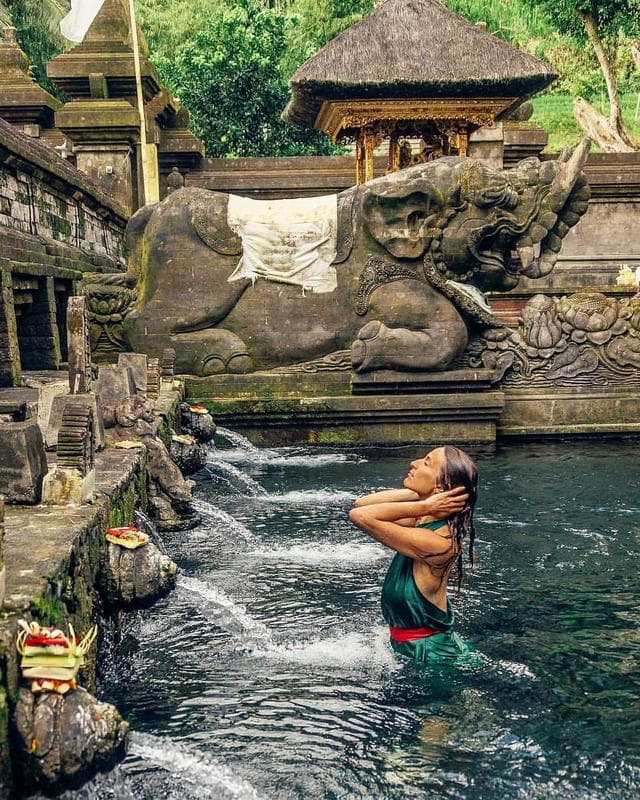
That is why the water matters. For Balinese Hindus, bathing under the spouts, a rite called melukat, cleanses body and mind. Each spout has a name and a purpose, from purification to healing and removing harmful influences, and Hindus who come to pray or bathe enter free. On full moon (Purnama) and new moon (Tilem) days whole families arrive with offerings, and the queue in the pool can run the length of the row.
Visitors of any religion may join, provided they follow the temple rules: a sarong and sash, no soap, swimwear only under a bathing sarong, and no bathing during menstruation, a custom that applies at every Balinese temple. You change into a rented green sarong, place an offering, then work along the spouts from the left, bowing your head under each one. If you only want to watch, the walkway around the pools gives a clear view, and the inner courtyard, where the spring fills a large pool among the shrines, is usually calmer.
Know what has changed. Foreign adults paid IDR 50,000 in 2023; by January 2025 the ticket was IDR 75,000. The busiest hours now run from about 10 am to 2 pm, when Ubud day tours arrive, and midday means a queue in the water and a crowd with phones on the edge. On the hill above stands Tampaksiring Palace, the presidential retreat Sukarno began building in 1957; it is not part of the temple visit. Come early, treat the pools as a place of worship rather than a photo set, and Tirta Empul is still one of the most meaningful mornings you can spend in Bali.
- Opening hours
- Daily about 8 am–6 pm (checked Oct 2026)
- Ticket
- IDR 75,000 adults, IDR 50,000 children (checked Oct 2026)
- Time needed
- 1 hour to look around; 1.5–2 hours if you bathe
- Best time
- At opening or after 4 pm; avoid full and new moon days
- Dress code
- Sarong and sash for everyone; bathing sarong rented separately
- Location
- Tampaksiring, 19 km north-east of Ubud (30–40 min)
Manukaya, Tampaksiring, Gianyar Regency, Bali, Indonesia
Open in Google MapsWhat to See
What to see at Tirta Empul.
- 01
Melukat, step 1: getting ready
Buy your ticket, then borrow or rent a sarong and sash at the entrance. In the middle courtyard, a counter rents green bathing sarongs (about IDR 10,000) and lockers (about IDR 15,000), cash only, according to a 2025 visitor report. Change in the separate men’s and women’s areas, which have no cubicles, with swimwear underneath. Then take a canang sari offering, add a small donation, place it at the shrine beside the pools and pray in your own way.
- 02
Melukat, step 2: under the spouts
Enter the main pool at the far left, where a row of 13 carved spouts begins, and queue behind the person ahead. At each spout, press your palms together for a silent prayer or wish, rinse your mouth three times without swallowing, wash your face three times, then let the water run over your head. Move right along the row, skipping the two spouts reserved for ceremonies for the dead. An attendant or the people ahead of you will show which they are.
- 03
The spring in the inner courtyard
Past the bathing pools lies the jeroan, the inner courtyard and the holiest part of the temple. Here the Tirta Empul spring fills a large pool surrounded by shrines to the gods, and this is the water that runs through the spouts and on into the Pakerisan River. Non-Hindus may enter if they wear a sarong and behave quietly. It is usually far calmer than the pools, and the best place to understand why the temple exists.
- 04
Watching from the pool edge
You do not have to get wet. The walkway along the pools lets you watch Balinese families work through the spouts, often in temple dress with offerings in hand, and on full and new moon days the rhythm of the ritual is clearer from the side than from the queue. Keep a respectful distance, ask before photographing anyone at prayer, and step aside for worshippers carrying offerings.
- 05
The koi pond and outer courtyard
The jaba, the outer courtyard you enter first, holds a large koi pond ringed by statues from Hindu mythology. It is the easiest place to get your bearings before the crowds in the pools, and the best spot for a photo of the temple without bathers in the frame. Give it a few minutes on the way out too, once the morning groups have left.
- 06
Tampaksiring Palace on the hill
Above the temple stands Istana Tampaksiring, a presidential palace Sukarno commissioned. Building began in 1957 with Wisma Merdeka, whose guest room looks over the temple toward the spring; a relief on its back veranda tells the Mayadenawa legend. It is a working state palace, not part of the temple ticket, and the State Secretariat says the public can visit only at certain times.
Seasons
Best time to visit Tirta Empul.
Come at opening, about 8 am, or after 4 pm. One 2025 visit found the pools quiet at 8 am, busy by 9:30 and packed around 1 pm, and guides put the peak at 10 am to 2 pm, when Ubud day tours arrive. Late afternoon light is softer, but the last hour feels rushed if you want to bathe and change.
Full moon (Purnama) and new moon (Tilem) days are the busiest of the month, as Balinese families come to pray and bathe; go then only if you want to see the temple at its most devout and do not mind a long queue. Galungan and Kuningan, next on 13 and 23 January 2027, bring similar crowds. The temple stays open on ceremony days, but on Nyepi, 8 March 2027, the whole island stays home and nobody travels.
Season matters less here than at waterfalls, since you get wet anyway. Dry-season mornings from April to October make the drive and the changing area more pleasant, while wet-season afternoons from November to March often bring heavy rain to the hills around Tampaksiring.
Getting There
How to get to Tirta Empul.
| From | Time | How |
|---|---|---|
| Central Ubud | 30–40 min | About 19 km north-east by car or scooter, either through Tegallalang or south-east through Bedulu and Pejeng on the Tampaksiring road. Most people come with a driver hired for the day. |
| Bali airport (DPS) | 1.5–2.5 hours | About 52 km by car through Denpasar and Gianyar. Pre-book a driver; traffic around Denpasar decides the time. |
| Seminyak or Canggu | 1.5–2.5 hours | About 47–49 km by car. Leave by 7 am to reach the pools before the midday crowd, and pair it with Tegallalang on the way back. |
| Sanur | 1–1.5 hours | About 37 km by car north through Gianyar regency. |
| Uluwatu or Nusa Dua | 2–3 hours | About 60–70 km by car. Too far for a quick visit; plan it during a night or two in Ubud instead. |
| Kintamani (Penelokan) | 30–40 min | About 19 km south by car on the main road down from the caldera rim. An easy stop on the way back from a Mount Batur sunrise trek. |
Getting around Tirta Empul
Cars and scooters park in a large lot by the entrance. Recent reports range from free to IDR 2,000 for a scooter and IDR 5,000 for a car, paid at the exit barrier. The walk from the lot to the gate is short, and the temple courtyards are close together, so this is one of the easier major temples for anyone who struggles with long stairways. Expect wet, slippery stone around the pools.
A driver hired for the day is the simplest way to visit, and lets you add Gunung Kawi, Tegallalang and Goa Gajah on the same loop. Tampaksiring is well outside central Ubud, so a Grab or Gojek back can take a while to find; book your return before you go in, or keep your driver. On a scooter, the roads from Ubud are good but busy with trucks and tour vans, so pack dry clothes in the seat box.
You do not need a guide, but one helps with the offering and explains the spouts. Guides approach visitors after they change; there is no official rate, so agree on a price first. One 2025 visitor paid IDR 100,000 for a group of four.
Know Before You Go
Tirta Empul tips that save time and trouble.
- 01Bring a towel, a dry change of clothes and a bag for wet things; the changing areas are shared, with no cubicles.
- 02Carry small cash for the bathing sarong, locker, offering and parking. There is an ATM by the ticket counter.
- 03Rinse your mouth but do not swallow the water, and never use soap or shampoo in the pools.
- 04Women who are menstruating should not enter the temple or the pools, by Balinese custom.
- 05Let worshippers go ahead of you, keep your voice low in the water, and do not pose for photo shoots under the spouts.
- 06Keep valuables in a locker; take only a phone in a waterproof pouch, or leave it with a guide or friend.
- 07Some 2025 visitors found the gate open from 7 am, but the official listing says 8 am, so do not plan around the earlier time.
- 08Gunung Kawi is 2 km down the road and also needs a sarong; see both in one morning before the heat.
FAQ
Tirta Empul questions, answered.
How much is the Tirta Empul entrance fee?
IDR 75,000 for adults and IDR 50,000 for children, with children under five free (checked Oct 2026). Foreign adults paid IDR 50,000 as recently as 2023. Balinese Hindus coming to pray or bathe do not pay. Budget extra cash for the bathing sarong, a locker, an offering and parking.
What are Tirta Empul’s opening hours?
Daily from about 8 am to 6 pm (checked Oct 2026), including public holidays and ceremony days. Some 2025 visitors found the gate open from 7 am, but the official listing says 8 am. Arrive at opening or after 4 pm; the busiest hours are roughly 10 am to 2 pm.
Can tourists do the purification ritual at Tirta Empul?
Yes. Melukat is open to people of any religion, as long as you wear a sarong and sash, follow the order of the spouts and treat it as worship rather than a swim. Rent a green bathing sarong and a locker in the middle courtyard, place an offering, then start at the left end of the main pool.
Which spouts should you skip at Tirta Empul?
Skip the two spouts reserved for ceremonies for the dead. Indonesia’s tourism board says an attendant will tell you which spouts are meant for general visitors, and some guides describe the two as clearly marked. If you are unsure, watch the Balinese ahead of you or ask before you step under.
What should I wear to Tirta Empul?
Clothes that cover your shoulders and knees, plus the sarong and sash lent or rented at the entrance; men need them too. To bathe, wear swimwear under a rented green bathing sarong, never swimwear on its own. Bring a towel, dry clothes and sandals you can slip off at the pool.
How long do you need at Tirta Empul?
About an hour to walk the courtyards and watch, or 1.5 to 2 hours if you bathe. One 2025 visitor spent 90 minutes in total, an hour of it on melukat. Add 30 to 40 minutes each way from Ubud, and another hour if you also visit Gunung Kawi.
Is Tirta Empul worth visiting?
Yes, if you go early and take part or watch respectfully. It is one of the few places in Bali where visitors can join a living Hindu ritual, and the legend and spring give it more depth than most temple stops. At midday, with queues in the pool, it can feel like an attraction rather than a temple, so time your visit.
Can you go to Tirta Empul on your period?
By Balinese custom, women who are menstruating should not enter temples or take part in melukat, as Indonesia’s public broadcaster RRI and visitor guides note. Nobody checks, but it is a matter of respect. If your dates clash, visit another day or simply skip the pools.
How far is Tirta Empul from Ubud?
About 19 km north-east of central Ubud, a drive of 30 to 40 minutes. From the airport, Seminyak or Canggu it is about 50 km and 1.5 to 2.5 hours, so most people visit from an Ubud base or on a full-day trip with a driver.
Do you need a guide at Tirta Empul?
No, but one helps. Attendants cover the basics, while a guide explains the spouts, helps with the offering and can hold your phone. There is no official rate; guides approach you after you change, so agree on a price first. One 2025 visitor paid IDR 100,000 for a group of four.
Nearby
Where to go after Tirta Empul.
Places close by that fit into the same trip, with honest travel times.
About 5 min by car (2 km)
Gunung Kawi Tampaksiring
Ten 11th-century shrines cut into the cliffs of the Pakerisan valley, reached by a long stairway through rice terraces.
15–20 min by car (7 km)
Tegallalang Rice Terrace
Bali’s most photographed terraces, best before 9 am and an easy stop on the way back to Ubud.
Visitor guide25–35 min by car (14 km)
Goa Gajah (Elephant Cave)
An 11th-century cave sanctuary with a carved demon-face doorway and old bathing pools, in Bedulu on the road south.
Visitor guide30–40 min by car (19 km)
Kintamani and Mount Batur
Views across the caldera and Lake Batur from the Penelokan ridge, or the sunrise trek up the volcano.
40–50 min by car (21 km)
Sacred Monkey Forest Sanctuary
Ravines, temples and more than 1,000 macaques at the south end of central Ubud.
Visitor guide
More in Ubud
Plan the rest of your time in Ubud.
How we researched this
Sources and fact checks.
Prices, opening hours, show times and travel times in this Tirta Empul guide were checked against official sites, government tourism pages and recent reporting on 14 October 2026. Where sources disagreed, we give the official figure and say so. Rankings are our editorial judgment, set out in our editorial policy.
We re-check the guide at least every three months and whenever we hear about a change. Spotted something out of date? Tell us.
Show all 14 sources ↓Hide sources ↑
- indonesia.travel/id-id/travel-ideas/pilgrimage/pura-tirta-empul
- indonesia.travel/uk/en/travel-ideas/pilgrimage/pura-tirta-empul
- setneg.go.id/baca/index/istana_tampak_siring
- rri.co.id/en/art-and-culture/2272843/tirta-empul-the-sacr…
- bali.antaranews.com/berita/313989/wisata-tirta-empul-jadi-destinasi…
- baliholidaysecrets.com/tirta-empul-temple
- baliuntold.com/things-to-do/temples/pura-tirta-empul
- en.wikipedia.org/wiki/Tirta_Empul_Temple%20(coordinates)
- en.wikipedia.org/wiki/Tampaksiring_Palace
- en.wikipedia.org/wiki/Gunung_Kawi
- nominatim.openstreetmap.org/ui/search.html
- map.project-osrm.org/%20(road%20distances%20to%20Ubud,%20the%20airpo…
- baliholidaysecrets.com/goa-gajah
- thebaliguideline.com/blog/must-see-temples-in-bali