
Kintamani · Wellness
Lake Batur Hot Springs at Toya Bungkah: A Visitor’s Guide
Bath-warm volcanic spring water on the lakeshore, a few minutes below the Batur trailhead.
By The Bali Guideline Editorial TeamUpdated 9 November 2026
Overview
Lake Batur Hot Springs, before you go.
Lake Batur’s hot springs rise at Toya Bungkah, on the west shore at the foot of Mount Batur in Kintamani, 1 to 1.5 hours north of Ubud. Spring water at about 38 to 40°C fills a village-run complex, a larger private resort and a few smaller pools. A soak is the obvious end to the sunrise trek and an easy add-on to any Kintamani day.
Toya Bungkah means, roughly, water from the rock: toya is water and bungkah a large block of stone. The springs seep from cracks in the lava on the west shore of Lake Batur, a few minutes’ drive from the main trailhead for the sunrise trek. Geologists place them on the outflow side of the Batur geothermal system, where heated groundwater moves sideways away from the crater and surfaces as warm springs of near-neutral pH. The water is clear and close to odorless, unlike the sulfur pools near Lovina.
To the village of Batur, the spring is sacred first and a pool second. It rises in the outer courtyard of Pura Tirta Mas Bungkah, and village elders say it has long been used for metamba, traditional healing; people still come to bathe for skin complaints and for melukat, ritual cleansing. Between 2007 and 2009 the village council took over the site, rebuilt the pools and reopened them as Batur Natural Hot Spring. It runs as community tourism: the operator says ticket money pays for village ceremonies and the temple’s upkeep, and every staff member comes from the village.
A short walk along the shore, Toya Devasya is the private alternative. It traces its start to the early 1990s and has grown into a resort with eight hot pools, an Olympic-size pool, water slides, lake activities, villas and a campsite. Smaller pools around the lake aim at Indonesian families: Seked Batur, open since 2012, charged IDR 20,000 for adults in December 2025, and detikBali measured its water at about 30°C. Some Toya Bungkah guesthouses also pipe spring water into small pools for their guests. No free public bath for visitors is listed today; every pool charges at the gate.
How hot is it? The village complex gives a steady 38 to 40°C, the temperature of a hot bath rather than a scald, and hot-spring guides list about 37 to 42°C at Toya Devasya, warmest near the inflows. After two hours on a cold, windy summit, that feels like a lot more.
Two practical points: price and timing. Foreign adults pay IDR 200,000 at the village complex, with towel and locker, against IDR 70,000 for Indonesians (checked Nov 2026). Both big complexes fill from mid-morning as trek groups come down, and the lake beyond the pool walls is fish-farmed and polluted, so soak in the pools, not the lake. Come straight off the trail, or wait until the tour vans have gone, and an hour in warm water with Mount Batur behind you is one of the best parts of a Kintamani day.
- Opening hours
- Village complex daily 7 AM–7 PM; Toya Devasya varies (checked Nov 2026)
- Ticket
- Village complex: IDR 200,000 foreign adults, 100,000 kids (checked Nov 2026)
- Time needed
- 1–2 hours; half a day with lunch or a lake trip
- Best time
- Straight after the sunrise trek, before 10 AM; June–September
- Dress code
- Swimwear in the pools only; cover up near the spring temple
- Location
- Toya Bungkah, west shore of Lake Batur; 1–1.5 hrs north of Ubud
Today at Lake Batur Hot Springs
- Daylight
- to
- Hours of light
- 12 hr 28 min of light
Checking the weather in Kintamani…
Times for this spot, in Bali time (WITA).
Jalan Raya Toya Bungkah, Batur, Kintamani, Bangli Regency, Bali, Indonesia
Open in Google MapsWhat to See
What to see at Lake Batur Hot Springs.
- 01
The village pools at Batur Natural Hot Spring
The community-run complex steps down the shore in a series of pools fed by running spring water, with cooler children’s pools and slides at one side. The ticket covers every pool, a towel and a locker, and the operator says there are no extra rental fees at the counter. Changing rooms, a lakeside restaurant and massage are on site. Tickets are sold only at the gate and by WhatsApp; the operator says it has no deal with third-party booking sites.
- 02
Pura Tirta Mas Bungkah and the healing spring
The spring itself rises in the outer courtyard of Pura Tirta Mas Bungkah, the village temple that the pool income helps maintain. Balinese come here for metamba, traditional healing, and for melukat, a cleansing bath with offerings and prayers. You may see families arrive with offerings. Keep swimwear inside the pool area, cover your shoulders near the shrines, and give anyone praying room and quiet.
- 03
Toya Devasya’s resort pools
The bigger private complex lists eight hot-spring pools plus an Olympic-size pool. They include infinity pools facing the lake and mountains, a cave-like pool and water slides for children. The operator drains and cleans the pools daily. Around them sit restaurants, villas, a hikers’ campsite and activities such as jet skis, boat trips, cycling and jeep tours. Indonesians and KITAS holders buy a cheaper Gold ticket; the Platinum ticket adds a towel and locker.
- 04
Soaking after the sunrise trek
Most climbers reach the trek parking lot near Toya Bungkah between about 8 and 9 AM, and both big complexes are about five minutes’ drive away. That is the ideal time to soak: legs stiff, clothes dusty, the pools still fairly calm. Pack swimwear and a dry layer in the car. Trek packages often treat the hot spring as an extra, so ask before you pay whether entry is included.
- 05
The view across the caldera
The pools face the lake with Mount Batur’s cone behind them and the long wall of Mount Abang, at 2,151 m the caldera’s highest point, rising on the far shore. In the morning the water is often glassy. Cloud tends to pour into the caldera from late morning, so if the view matters more than the water, come early.
- 06
Cheaper, cooler local pools
Not every pool on the lake is aimed at foreigners. Seked Batur, which opened in 2012, covers about two hectares with a main pool, a shallow pool with fish-statue spouts, a café and villas, and charged adults IDR 20,000 in December 2025. Its manager told detikBali that almost all visitors are Indonesian. Expect warm rather than hot water: detikBali measured about 30°C, and a local guide said only one pool is properly hot.
- 07
Lake fish for lunch
Lake Batur’s tilapia farms supply the lakeshore warungs, and the dish to try is mujair nyat-nyat, tilapia braised in a thick Balinese spice paste until the sauce clings. It appears on menus around the hot springs and in the warungs by the Kedisan boat dock, about 10 minutes away. Pair it with plecing kangkung, water spinach with a fresh chili and tomato sambal.
Seasons
Best time to visit Lake Batur Hot Springs.
For a calm soak, come early. The village complex opens at 7 AM, and climbers arrive from about 8 AM, so the hour before 10 AM is busy but manageable. From mid-morning, tour groups fill both big complexes. Day tours run on a morning schedule, so late afternoon is usually quieter, but the village pools close at 7 PM and the drive back up the hairpins in fog is slow.
June to September brings the clearest mornings and the best chance of seeing Batur and Abang from the water. Rainfall in Kintamani rises from about 65 mm in August to more than 400 mm in January, and from December to March cloud can hide the view entirely. Warm water in cold rain is still a good way to spend a wet morning.
Indonesian holidays and long weekends bring domestic crowds. The springs, like all of Bali, close on Nyepi, next on 8 March 2027. On temple days at Pura Tirta Mas Bungkah you may see melukat ceremonies at the spring, a reason to slow down rather than stay away.
Coming between November and March? Read our Bali rainy season guide →
Getting There
How to get to Lake Batur Hot Springs.
| From | Time | How |
|---|---|---|
| Ubud | 1–1.5 hours | About 44 km north by car via Tegallalang and Penelokan, then down the hairpins to the lake and north along the shore. |
| Penelokan (Kintamani rim) | 15–20 min | About 8 km down the steep hairpin road to Kedisan, then about 5 km north along the west shore to Toya Bungkah. |
| Sanur | 1.5–2 hours | About 64 km by car north through Gianyar and Bangli. |
| Seminyak or Canggu | 2–2.5 hours | About 73 km by car. Better on a day that includes the trek or a night in Ubud than as a round trip just to soak. |
| Bali airport (DPS) | 2–3 hours | About 77 km by car; longer in afternoon traffic around Denpasar. |
| Uluwatu, Jimbaran or Nusa Dua | 2.5–3 hours | About 85–94 km by car. Combine it with the trek or a night in Kintamani. |
| Lovina and the north coast | 1.5–2 hours | About 73 km by car via Singaraja and over the north rim at Penulisan. |
Getting around Lake Batur Hot Springs
Toya Bungkah sits at the bottom of the caldera, so every route ends on the hairpin road down from Penelokan. Bangli regency runs fee posts on the main roads into Kintamani, where foreign adults pay an IDR 50,000 area fee between 8 AM and 5 PM; this is separate from the hot-spring ticket. The two big complexes sit off the lakeshore road a short walk apart.
Most visitors arrive with a driver, either on a trek or jeep package or on a Kintamani day tour from Ubud. Grab and Gojek drivers rarely wait at the bottom of the caldera, so do not count on an app ride back up; keep your driver or arrange a return before you go in. A scooter works in dry weather, but the hairpins are steep, sand trucks use them, and fog can roll in by afternoon.
Inside, the pools are linked by short flights of steps, and tiled edges stay wet. Wear sandals with grip and carry them to the poolside.
Tickets & Tours
Lake Batur Hot Springs tours on Klook.
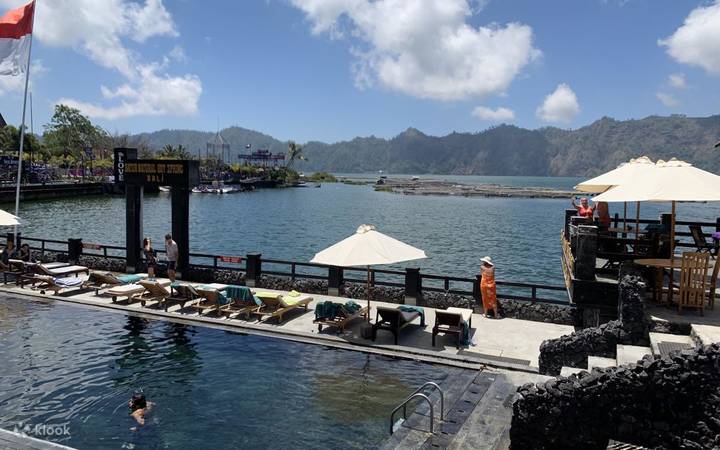
You can visit on your own with the details above. If you would rather have the driver, guide or entry sorted, these Klook tours include Lake Batur Hot Springs. Prices, pick-up areas and what is included vary, so check the listing before you book.
Affiliate links: we may earn a commission if you book, at no extra cost to you. Affiliate disclosure
Know Before You Go
Lake Batur Hot Springs tips that save time and trouble.
- 01Pack swimwear, flip-flops and a dry layer; towels and lockers are included at the village complex.
- 02Buy tickets at the gate or by WhatsApp with the operator; the village complex says it does not sell through third-party sites.
- 03Ask whether your trek or jeep package includes hot-spring entry before you pay.
- 04Drink water before you get in. After a sunrise climb, hot water and dehydration make some people light-headed.
- 05Keep sessions in the hottest pools to about 15 to 20 minutes and test the water before you sink in.
- 06Watch children closely on the slides and wet steps, and do not count on a lifeguard.
- 07Soak in the pools, not the lake: Lake Batur is fish-farmed and polluted.
- 08Carry small cash for the Kintamani area fee, parking and warungs.
- 09Keep swimwear out of the temple courtyards and step back when a ceremony starts at the spring.
FAQ
Lake Batur Hot Springs questions, answered.
How much do the Lake Batur hot springs cost?
At the village-run Batur Natural Hot Spring, foreign adults pay IDR 200,000 and foreign children IDR 100,000, with towel and locker included; Indonesians pay IDR 70,000 (checked Nov 2026). Toya Devasya does not publish prices on its site; resellers list its Platinum ticket for foreign visitors at about IDR 175,000 to 195,000. Smaller local pools such as Seked Batur charge about IDR 20,000.
What are the opening hours of the hot springs at Toya Bungkah?
Batur Natural Hot Spring is open daily from 7 AM to 7 PM, according to the operator (checked Nov 2026). Listed hours for Toya Devasya vary by booking site, from a 7, 8 or 9 AM opening to a 5 or 6 PM close, so confirm with the resort on the day. Everything closes on Nyepi, next on 8 March 2027.
How hot is the water in the Batur hot springs?
About 38 to 40°C at Batur Natural Hot Spring, which the operator says stays constant year-round. Hot-spring guides put Toya Devasya’s pools at about 37 to 42°C, hottest near the inflows. Children’s pools run cooler, and the small local pool at Seked Batur measured only about 30°C in December 2025. The water is clear and nearly odorless.
What is the difference between Batur Natural Hot Spring and Toya Devasya?
Ownership and scale. Batur Natural Hot Spring belongs to the village, sits on the spring in the courtyard of Pura Tirta Mas Bungkah, and puts its income into village ceremonies. Toya Devasya is a private resort with more pools, an Olympic-size pool, slides, villas, camping and lake activities. Both use spring water and face the lake, and both fill when trek groups come down.
Is there a free public hot spring at Toya Bungkah?
Not for visitors. The spring that villagers have used for healing and cleansing for generations now feeds the ticketed village complex, and every other pool on the shore charges at the gate. The cheapest option is a small local pool such as Seked Batur, about IDR 20,000 for adults in December 2025, though its water is much cooler.
Can you combine the hot springs with the Mount Batur sunrise trek?
Yes, it is the classic pairing. The trek starts and ends at a parking lot near Toya Bungkah, about five minutes’ drive from the pools. You are usually down by 8 or 9 AM, in time for a soak before the late-morning rush. Many trek and jeep packages offer the hot spring as an add-on, so check whether entry is included.
How do you get to the Lake Batur hot springs from Ubud?
By car or scooter, about 44 km and 1 to 1.5 hours. Drive north through Tegallalang to Penelokan on the caldera rim, then down the hairpins to Kedisan and about 5 km along the west shore to Toya Bungkah. Most people come with a driver, because app rides rarely wait at the bottom of the caldera.
What should you bring to the hot springs?
Swimwear, flip-flops, a dry layer and some cash. The village complex includes a towel and locker in the ticket; at Toya Devasya the cheaper ticket does not. Bring water to drink, especially after the trek, and a bag for wet clothes. Leave valuables in the locker or with your driver.
Can you swim in Lake Batur?
It is not a good idea. The lake is used for tilapia farming, and fish farms and farm runoff pollute the water. The hot-spring pools on the shore give you the lake view without the risk, and boats from the Kedisan dock are the way to get out on the water.
Are the Batur hot springs good for children?
Yes, with care. Both big complexes have cooler children’s pools and water slides. Keep small children out of the hottest pools, watch them on wet steps, and do not assume a lifeguard is on duty. Toya Devasya’s larger site has more for older children, while the village complex is smaller and easier to keep an eye on.
Is it safe to visit the hot springs near an active volcano?
Yes, in normal conditions. MAGMA Indonesia, the government volcano service, listed Mount Batur at Level I (Normal), the lowest of four alert levels (checked Nov 2026). The springs are on the lakeshore, well away from the crater. Check the level on magma.esdm.go.id before you travel, and follow any local closure.
Are the Lake Batur hot springs worth it?
Yes, if you are already in Kintamani, and especially after the sunrise trek. Warm water with Mount Batur behind you is a real pleasure after a cold summit. On its own, though, a soak hardly justifies a 2-hour drive from the south.
Nearby
Where to go after Lake Batur Hot Springs.
Places close by that fit into the same trip, with realistic travel times.
About 5 min by car (1 km)
Mount Batur sunrise trek
The guided dawn climb starts and ends a few minutes from the pools, which is why most people arrive here straight off the trail by 9 AM.
Visitor guide25–35 min by car (13 km)
Pura Ulun Danu Batur
Bali’s supreme water temple on the caldera rim, rebuilt there after the 1926 eruption buried the old village below.
Visitor guide15–20 min by car (8 km)
Penelokan caldera viewpoint
The whole caldera from the rim road: the cone, the lava fields and the lake you have just soaked beside.
10 min to Kedisan dock (6 km), then 15–30 min by boat
Trunyan village and cemetery
A Bali Aga village across the lake where the dead are laid under bamboo cages; agree on the full boat price first.
25–30 min by car (14 km)
Pinggan sunrise viewpoint
The non-hiker’s sunrise on the north rim, with mist in the caldera on good dry-season mornings.
50–60 min by car (26 km)
Tirta Empul
A spring temple of a different kind, where you can join the purification ritual on the way back to Ubud.
Visitor guide
More in Kintamani
Plan the rest of your time in Kintamani.
How we researched this
Sources and fact checks.
Prices, opening hours, show times and travel times in this Lake Batur Hot Springs guide were checked against official sites, government tourism pages and recent reporting on 9 November 2026. Where sources disagreed, we give the official figure and say so. Rankings are our editorial judgment, set out in our editorial policy.
We re-check the guide at least every three months and whenever we hear about a change. Spotted something out of date? Tell us.
Show all 18 sources ↓Hide sources ↑
- baturnaturalhotspring.com/natural-hot-spring
- baturnaturalhotspring.com/about-us
- toyadevasya.com/home-hotspring
- toyadevasya.com/home-pool-1
- toyadevasya.com/home-about-2
- magma.esdm.go.id/v1/gunung-api/tingkat-aktivitas
- detik.com/bali/wisata/d-8268804/sensasi-berendam-air-hang…
- sia.akademik.unsoed.ac.id/artikelilmiah/update
- traveloka.com/en-en/activities/indonesia/product/200007933624…
- expedia.co.id/things-to-do/a.a52248545.activity-details
- pelago.com/en/activity/p773xng00-toya-devasya-natural-hot-…
- hotspringsguides.com/hot-springs/batur-natural-hot-spring-indonesia
- hotspringsguides.com/hot-springs/toya-devasya-hot-spring-indonesia
- findinghotsprings.com/mag/toya-devasya-bali
- de.wikivoyage.org/wiki/Danau_Batur
- en.wikivoyage.org/wiki/Kintamani
- openstreetmap.org
- router.project-osrm.org