
Uluwatu · Temple
Uluwatu Temple and the Kecak Fire Dance: A Visitor’s Guide
A sea temple on a 70-meter cliff, a sunset Kecak and monkeys that ransom sunglasses.
By The Bali Guideline Editorial TeamUpdated 14 October 2026
Overview
Uluwatu Temple, before you go.
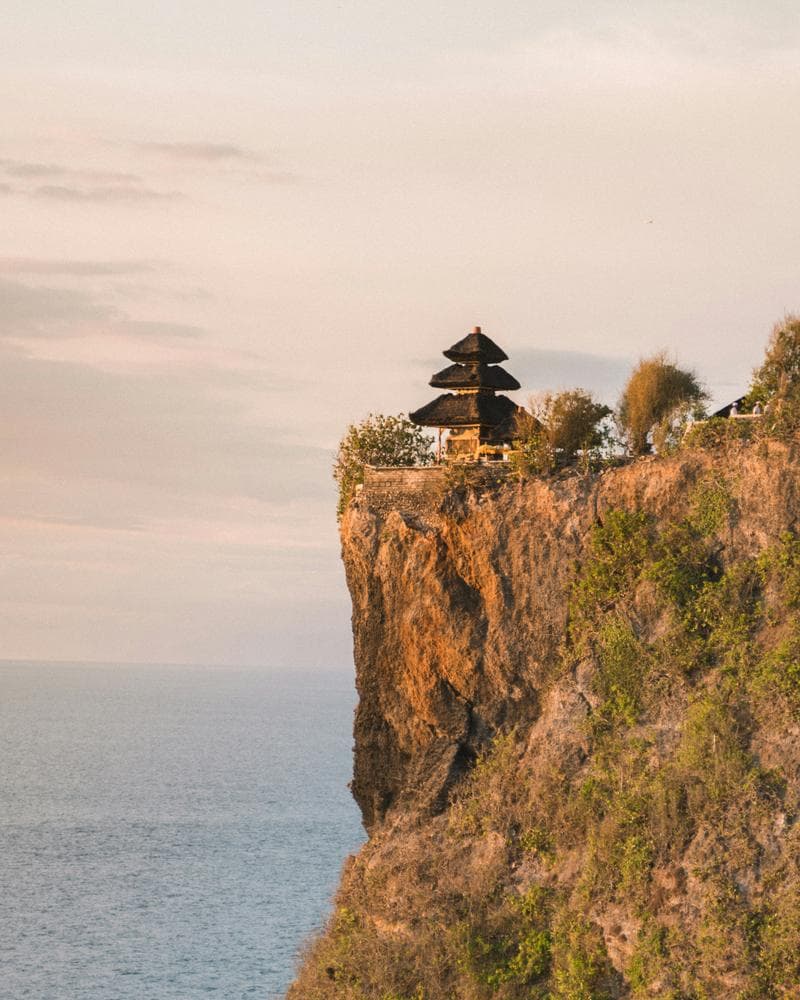
Uluwatu Temple (Pura Luhur Uluwatu) is a Balinese sea temple on a limestone cliff about 70 meters above the Indian Ocean, at the southwest tip of the Bukit Peninsula and 45 to 90 minutes from the airport. It is worth it for almost everyone: an hour on the cliff paths in the late afternoon, then the 6 pm Kecak fire dance in the amphitheater beside it.
Pura Luhur Uluwatu is one of Bali’s sad kahyangan, the six sanctuaries Balinese Hindus believe hold the island in spiritual balance, and the directional temple that guards the southwest against forces from the sea. It is dedicated to Shiva in his form as Rudra. The name describes the place: ulu means edge or top, watu means rock, and the shrine sits on a limestone point about 70 meters above the waves.
Most histories date the temple to the 11th century, when the Javanese sage Mpu Kuturan expanded it, although a gate in the complex carries a chronogram for 808 Saka, or 886 CE. In the 16th century the priest Dang Hyang Nirartha built padmasana shrines here and is believed to have reached moksha, final spiritual release, on this cliff. Balinese call that moment ngeluhur, “to go up,” which gave the temple its title Luhur. Its piodalan, the temple anniversary, comes every 210 days on Anggara Kasih Medangsia in the Balinese calendar and lasts about three days, when thousands of worshippers arrive with offerings.
That history sets the rules for visitors. The inner courtyards are for worship only, so you see the tiered shrine from the walled cliff paths on either side, not from inside. The visit is a walk through the temple forest and along the cliff top, with long views down to the reef and the surf. The full loop takes about an hour.
You share the paths with long-tailed macaques, 333 of them in five groups at the last published count. They grab glasses, phones and hats, and hand them back only when staff throw them enough fruit. A 2021 study found they hold out for more food when they have stolen something valuable.
Most people come for the evening. The Kecak starts at 6 pm in an open-air amphitheater on the cliff south of the temple, and in the dry season the sun drops into the ocean 10 to 20 minutes into the show. The arena seats about 1,200, the 6 pm show sells out in July, August and late December, and the main road back toward Jimbaran jams when everyone leaves at once.
One price note: the management’s current ticket pages list IDR 60,000 for foreign adults, while its older FAQ and many guides still quote IDR 50,000. Bring enough cash for the higher figure, plus the separate Kecak ticket and parking.
- Opening hours
- Daily 7 am–7 pm; Kecak from 6 pm (checked Oct 2026)
- Ticket
- About IDR 60,000 foreign adults; Kecak IDR 150,000 extra (checked Oct 2026)
- Time needed
- 1 hour for the cliff paths, 3–4 hours with the Kecak
- Best time
- Arrive 4–4:30 pm for the walk, sunset and the 6 pm Kecak
- Dress code
- Sarong and sash required, both included with the ticket
- Location
- Southwest tip of the Bukit, Pecatu; 45–90 min from the airport
Pura Luhur Uluwatu, Jalan Raya Uluwatu, Pecatu, Kuta Selatan, Badung, Bali 80361
Open in Google MapsWhat to See
What to see at Uluwatu Temple.
- 01
The cliff paths and the classic view
Walled paths run along the cliff top on the north and south sides of the temple. From the northern side you look south across the cove to the tiered shrine on its point, the view on most postcards, and the southern side leads past more viewpoints to the Kecak amphitheater. The walls are roughly shoulder height, high enough to stop you falling and low enough for a monkey to reach your hands. Walk both sides in about an hour.
- 02
The temple gates and shrines
Visitors stay outside the inner courtyards, but you can stand at the split gates, guarded by elephant-headed Ganesha statues, and see the shrines above the wall. Behind the main shrine a statue of a Brahmin priest faces the ocean. On ceremony days families climb to the gates with offerings. Step aside, do not stand above or in front of people praying, and never walk through a procession.
- 03
The monkeys and their trading habit
The temple’s long-tailed macaques have turned theft into trade. They snatch sunglasses, prescription glasses, phones, hats and flip-flops, then wait on a wall while staff throw fruit or eggs until they let go. Researchers who watched them for 273 days found that a monkey holding a phone or glasses waits for more food than one holding an empty bag. Staff run a supervised feeding every Sunday at 4 pm by the Kumba Karna statue.
- 04
The Kecak fire dance
About 50 bare-chested men sit in rings and chant “cak” for an hour, with no instruments, while costumed dancers act out the Ramayana: Prince Rama, his wife Sita, the demon king Ravana who abducts her, and Hanuman, the white monkey who finds her. Kecak grew out of the chorus of the sacred Sanghyang trance ritual and took its stage form in the 1930s, when dancer Wayan Limbak worked with the German painter Walter Spies. The finale is the burning of Hanuman, who dances and kicks through fire.
- 05
Sunset over the Indian Ocean
The cliff faces west over open water, so this is one of the few places on the Bukit where the sun sinks straight into the sea. Sunset falls between about 6:05 pm in late May and 6:50 pm in late January, so from May to October it lands early in the 6 pm Kecak, and in January and February near the end. If you skip the show, stay on the cliff path until closing at 7 pm.
- 06
Seats in the Kecak amphitheater
Seating is first come, first served, and staff direct people into rows as the arena fills. The top rows in the center give the clearest view of the whole circle and a wall to lean on. The front rows are closest to the dancers and to the smoke and heat of the fire scene, with no backrest. For the 6 pm show the upper rows on the far right get shade sooner, which matters in the dry season.
Seasons
Best time to visit Uluwatu Temple.
Arrive between 4 and 4:30 pm. That gives you an hour on the cliff paths in softer light, time to buy the Kecak ticket, and a decent seat for the 6 pm show. The official advice is to be there before 5 pm, and to arrive at the earlier end in high season. Mornings from 7 am are cooler and much quieter if you only want the temple, though the monkeys are just as active.
The dry season, April to October, gives the clearest sunsets. From November to March clouds often hide the sun, and rain does not stop the Kecak: staff hand out ponchos or umbrellas, but the fire scene may be cut short, and tickets are not refunded. The busiest weeks are July, August, Christmas to New Year and Indonesian holidays, when the 6 pm show can sell out and a second 7 pm show is sometimes added.
The temple stays open on ceremony days, but the piodalan, every 210 days, brings thousands of worshippers for about three days and makes the paths much busier, so ask your hotel whether one falls during your stay. The temple and the Kecak close on Nyepi, Bali’s Day of Silence, usually in March, and there is no show on the evening before.
Getting There
How to get to Uluwatu Temple.
| From | Time | How |
|---|---|---|
| Padang Padang and Jalan Labuansait | 10–15 min | Scooter or car south along Jalan Raya Uluwatu, about 4 km. Allow extra time after 4 pm, when Kecak traffic builds. |
| Ngurah Rai Airport (DPS) | 45–90 min | Car via Jimbaran, about 21 km. Private transfers cost roughly USD 35–45. Avoid the 4–7 pm window, when the Jimbaran junction jams. |
| Jimbaran | 25–40 min | Car or scooter up Jalan Raya Uluwatu, about 12 km. The junction at the Jimbaran end is the main afternoon bottleneck. |
| Kuta and Seminyak | 1–2 hours | Car or driver via the bypass and Jimbaran: about 1–1.5 hours from Kuta and 1.25–2 hours from Seminyak. Leave before 3 pm for the Kecak. |
| Canggu | 1.5–2.5 hours | Car or driver by road, or GoBoat’s scheduled boat from Nelayan Beach to Padang Padang (about 35 min, weather permitting), then 10–15 min by car. |
| Nusa Dua and Sanur | 30 min–1.5 hours | About 30–45 min across the Bukit from Nusa Dua, 1–1.5 hours from Sanur via the Bali Mandara toll road. |
| Ubud | 2–3 hours | Private driver, usually as a long afternoon trip with the Kecak. Agree on the return before you set off. |
Getting around Uluwatu Temple
Park in the main lot by the temple; parking is paid separately and is cheap, about IDR 2,000 for a scooter and IDR 5,000 for a car, cash. Buy your temple ticket at the official booth by the main gate, put on the sarong and sash, then follow the paved path through the forest to the cliff. Expect some steps along the cliff paths; the management lists wheelchairs among its facilities, but not every viewpoint is step-free.
Grab and Gojek drop off at the temple without trouble, but local transport groups restrict app pickups inside the car park, so drivers usually ask you to walk out to the main road. After dark, taxis are scarce and one-way fares back to Seminyak or Canggu climb. The easiest plan is a driver who waits, or a return booked with the person who brought you.
When the Kecak ends, about 1,200 people walk back through the forest at once and the road out jams for half an hour or more. Either leave as the final scene winds down, or let the crowd go first and walk the empty path slowly. With a scooter, keep your helmet and anything on the seat out of reach of the monkeys.
Know Before You Go
Uluwatu Temple tips that save time and trouble.
- 01Bring cash in small notes. The temple ticket, the Kecak ticket and parking are paid separately, and card payment is not reliable at the counters. An ATM sits by the entrance.
- 02Put sunglasses, prescription glasses, hats and dangling earrings in a zipped bag before you leave the car, and hold your phone with both hands on the cliff path.
- 03If a monkey takes something, do not chase it or grab it back. Find a staff member, who will trade fruit for it; a small tip is customary.
- 04Do not bring food or drinks onto the temple grounds. They attract monkeys and are not allowed in the temple area.
- 05Under local custom, women who are menstruating are asked not to enter the temple area.
- 06Drones are not allowed without permission, and you should not climb the cliff walls for photos.
- 07Buy water before you reach the amphitheater, which has no vendors inside, and use the toilet before the show, which runs about an hour without a break.
- 08Book the Kecak a few days ahead in July, August and late December, or be in the queue by 4 pm.
- 09Agree on your ride home before the show. App pickups are restricted at the car park and taxis are scarce after dark.
FAQ
Uluwatu Temple questions, answered.
How much is the Uluwatu Temple entrance fee?
About IDR 60,000 for foreign adults and IDR 40,000 for foreign children, according to the management’s own ticket pages in October 2026. Indonesian visitors pay about IDR 40,000. Some guides and the site’s older FAQ still say IDR 50,000, so bring enough cash for the higher figure. The ticket includes a sarong and sash. Parking and the Kecak are paid separately.
What are Uluwatu Temple’s opening hours?
The temple is open daily from 7 am to 7 pm. The Kecak amphitheater gate opens at 4 pm for the 6 pm show. The temple and the Kecak close on Nyepi, Bali’s Day of Silence, usually in March, and the temple is much busier during its three-day piodalan festival every 210 days.
What time is the Kecak dance at Uluwatu?
The official schedule is one show daily from 6 to 7 pm, with the gate opening at 4 pm. On busy evenings a second show runs from 7 to 8 pm, and online resellers sell tickets for it. The 6 pm show catches the sunset in most months; the 7 pm show is darker, so the fire scene looks brighter, but the queue to get in can be a crush.
How much are Kecak tickets at Uluwatu and where do I buy them?
IDR 150,000 for adults and IDR 75,000 for children aged 2 to 9 (checked Oct 2026), on top of the temple ticket. Buy them in cash at the official Kecak booth near the temple entrance, or ahead through the official WhatsApp contacts or an online reseller. Online tickets usually come with a separate entry line, but resellers can add a markup.
How early should I arrive for the Uluwatu Kecak?
Be at the temple by 4 to 4:30 pm if you want a good seat at the 6 pm show and time to walk the cliff first. The management says to arrive before 5 pm, and people who turn up at 5 pm in high season can find the 6 pm show sold out. With an online ticket you can arrive a little later, but seats are first come, first served.
Is the Kecak dance at Uluwatu worth it?
Yes, for most first-time visitors. The setting, a cliff above the ocean at sunset, is what sets it apart from other Kecak shows in Bali. The catches are the crowd, hard benches for an hour and the traffic afterwards. If that sounds like too much, walk the temple in the morning and see a smaller Kecak at Melasti Beach or in Ubud instead.
Are the monkeys at Uluwatu Temple dangerous?
They are more thieves than threats, but they can scratch or bite if you grab back what they took or tease them with food. Keep loose items zipped away, do not feed them, and stay calm if one climbs near you. If something is stolen, find a staff member, who will trade fruit for it. The management runs first aid at the visitor center for bites and scratches.
What should I wear to Uluwatu Temple?
Cover your shoulders and knees if you can, but you do not need your own sarong: a sarong and sash come with the ticket and staff help you tie them. Wear shoes with grip for the cliff paths. Leave hats and sunglasses in your bag because of the monkeys, and avoid flashy jewelry, which the temple rules also discourage.
Can you go inside Uluwatu Temple?
No. The inner courtyards are reserved for worshippers and temple staff. Visitors walk the forest and the cliff paths around the temple, look through the gates and watch the Kecak in the amphitheater outside the temple walls. The best views of the shrine itself come from the cliff paths, not from close up.
Does the Uluwatu Kecak go ahead in the rain?
Usually, yes. The Kecak runs in light and even heavy rain, and staff hand out ponchos or umbrellas, but the fire scene may be shortened or skipped. Tickets are not refunded for weather. Full cancellations are rare. If the forecast is bad for a whole evening, consider moving your visit to another day.
How do I get back from Uluwatu Temple after the Kecak?
The easiest way is with the driver who brought you, agreed in advance. App pickups are restricted in the temple car park, so if you rely on Grab or Gojek, walk out to the main road and expect a wait while the crowd clears. Taxis are scarce after dark and one-way fares to Seminyak or Canggu are high.
Nearby
Where to go after Uluwatu Temple.
Places close by that fit into the same trip, with honest travel times.
10–15 min by car
Padang Padang Beach
A sheltered cove through a crack in the cliff, with calm water for a swim before the temple.
Visitor guide5–10 min by car
Suluban Beach and Single Fin
The cave beach below the Uluwatu surf break, and the cliff bar above it for sunset drinks.
10 min by car, then a 15–20 min walk down
Nyang Nyang Beach
A long, nearly empty beach with a shipwreck at the far end, for those who can face the climb back.
15 min by car
Bingin Beach
Rock pools at low tide and one of Bali’s most reliable left-hand barrels.
Visitor guide25–35 min by car
Melasti Beach
Calm water below white cliffs, and a Kecak of its own if the temple show is sold out.
Visitor guide25–40 min by car
Garuda Wisnu Kencana (GWK)
The giant Vishnu-on-Garuda statue and daytime dance shows, a good stop before the temple.
Visitor guide
More in Uluwatu
Plan the rest of your time in Uluwatu.
How we researched this
Sources and fact checks.
Prices, opening hours, show times and travel times in this Uluwatu Temple guide were checked against official sites, government tourism pages and recent reporting on 14 October 2026. Where sources disagreed, we give the official figure and say so. Rankings are our editorial judgment, set out in our editorial policy.
We re-check the guide at least every three months and whenever we hear about a change. Spotted something out of date? Tell us.
Show all 28 sources ↓Hide sources ↑
- uluwatutemple.id
- uluwatutemple.id/uluwatu-temple
- uluwatutemple.id/uluwatu-kecak-dance
- uluwatutemple.id/article/uluwatu-temple-entrance-fee-2026-and-wh…
- uluwatutemple.id/article/temple-ticket-and-kecak-ticket-are-diff…
- uluwatutemple.id/article/do-you-know-the-best-time-to-arrive-for…
- uluwatutemple.id/article/7-quick-facts-about-uluwatu-monkeys-tha…
- uluwatutemple.id/article/the-five-wonderful-beauties-of-uluwatu-…
- indonesia.travel/id-id/travel-ideas/pilgrimage/pura-uluwatu
- en.wikipedia.org/wiki/Uluwatu_Temple%20(coordinates)
- en.wikipedia.org/wiki/Kecak
- pmc.ncbi.nlm.nih.gov/articles/PMC7815422
- cbc.ca/1.5882682
- jurnal.peneliti.net/index.php/JIWP/article/view/6892
- bali.com/places/pura-luhur-uluwatu
- baliuntold.com/destinations/uluwatu/kecak-dance-at-uluwatu-tem…
- baliholidaysecrets.com/uluwatu-kecak-dance
- baliholidaysecrets.com/how-to-get-to-uluwatu
- inivie.com/discover-bali/pura-uluwatu-bali
- inivie.com/discover-bali/tari-kecak-uluwatu-mulai-jam-bera…
- theworldtravelguy.com/uluwatu-temple-bali-famous-cliff-sunset-uluwatu…
- theungasan.com/blog/your-guide-to-uluwatu-temple
- pelago.com/en-US/activity/ppiyy2jge-uluwatu-kecak-fire-dan…
- sunrise-sunset.org/api
- openstreetmap.org
- thebaliguideline.com/blog/must-see-temples-in-bali
- thebaliguideline.com/blog/8-places-must-explore-in-uluwatu
- thebaliguideline.com/blog/must-things-to-do-in-bali