
Candidasa · Culture
Tenganan Pegringsingan Village: A Respectful Visitor’s Guide
A walled Bali Aga village above Candidasa, where geringsing is still woven by hand.
By The Bali Guideline Editorial TeamUpdated 9 November 2026
Overview
Tenganan Pegringsingan Village, before you go.
Tenganan Pegringsingan is a walled Bali Aga village 4.5 km north of Candidasa in East Bali, home to about 700 people who keep customs older than the island’s Majapahit-era Hinduism. Entry is by donation in daylight hours, and one to two hours is enough. Go for living culture and the rare geringsing cloth; skip it if you want a show.
Tenganan Pegringsingan is one of a handful of Bali Aga villages, communities that trace their customs to Bali before the Majapahit conquest of the 14th century. A wall encloses three neighborhoods, or banjar: Kauh to the west, Tengah in the middle and Pande to the east. Family compounds of brick, river stone and thatch face each other in long rows across a broad, stepped stone concourse that climbs from the southern gate toward Pura Puseh, the temple of origin. Open pavilions run down the middle, among them the long Bale Agung, where the village council meets, and a tower whose wooden kul-kul drum is beaten 21 times each morning to start the day.
Life here still runs on awig-awig, customary law said to have been written in the 11th century and renewed in 1842. The village holds its roughly 917 hectares of rice fields, gardens and forest in common, so no one owns land privately. Trees may be felled only with the village meeting’s approval, and fruit such as durian is gathered only once it has fallen. Full membership traditionally belongs to people born here, and villagers have been expected to marry within the community; those who married out lost their place, although contact with the outside world has softened the rule. A 2025 report counted 688 residents in 255 families. The origin story says Indra granted the land: when a king’s sacred horse was found dead, the villagers who found it were promised all the ground over which its smell carried, and they spread the carcass far and wide.
The village is best known for geringsing, a cotton double ikat. Both the warp and the weft are tie-dyed before weaving, so the pattern appears only when they meet on the loom, and double ikat is made in just three places: here, in Gujarat in India and in Okinawa in Japan. The name is usually read as gering, illness, and sing, not, a cloth that keeps sickness away, and it is worn or laid out at hair-cutting rites, tooth filings, weddings and funerals. Dyeing is the slow part. Threads soak for weeks in candlenut oil and ash water, the indigo is dyed in nearby Bugbug, and red from morinda root bark is laid on again and again. One 2014 account put a single length at six to eight years.
Tenganan stayed largely closed to outsiders until the 1970s. Today you sign a guest book and leave a donation at the entrance, and about seven in ten visitors are foreign, staff at the desk told a reporter in 2025. Many front rooms double as workshops where women weave and men etch prasi, drawings scratched into lontar palm leaves and rubbed with burnt candlenut. Expect to be invited in and offered cloth, palm-leaf art and baskets. A polite “no, thank you” is fine, and there is no obligation to buy. Outsiders cannot stay the night, and you should not wander into temples, family compounds or pavilions in ritual use. Come for an hour of quiet looking, not a performance. The exception is June, when the Perang Pandan turns the center of the village into an arena.
- Opening hours
- Daily, about 8 AM–6 PM (some list 7 AM); daylight only (checked Nov 2026)
- Ticket
- Donation, no set price; about IDR 50,000 is typical (checked Nov 2026)
- Time needed
- 1–2 hours; half a day with the Kastala walk
- Best time
- Weekday mornings; June for the Perang Pandan
- Dress code
- No sarong needed; cover shoulders and knees
- Location
- 4.5 km north of Candidasa, Manggis, Karangasem
Today at Tenganan Pegringsingan Village
- Daylight
- to
- Hours of light
- 12 hr 28 min of light
Checking the weather in Candidasa…
Times for this spot, in Bali time (WITA).
Desa Tenganan Pegringsingan, Manggis, Karangasem Regency, Bali 80871, Indonesia
Open in Google MapsWhat to See
What to see at Tenganan Pegringsingan Village.
- 01
The stone concourse and its pavilions
From the southern gate, flanked by two small shrines, a wide paved concourse climbs north in low terraces between the family compounds. Each house opens onto it through a doorway barely wide enough for one person. Down the middle stand the open pavilions of village life: the long Bale Agung, where the village council makes its decisions, the communal bale where villagers gather, and the kul-kul tower. Look, but do not sit on pavilions in ritual use.
- 02
Geringsing weaving
Women weave geringsing on simple wooden looms in their homes, and almost every woman in the village can weave. The cloth comes in about two dozen named motifs, some so complex that only a few weavers still make them, in deep red, indigo-black and the cream of the undyed cotton. Each piece is made slowly and by hand, so a loom may be idle on the day you visit. Ask before you photograph a weaver at work.
- 03
Prasi drawings on palm leaves
Prasi is the village’s other fine craft: a knife scratches figures into strips of dried lontar palm leaf, and the lines are blackened with burnt candlenut. It was once used to record village law; today it shows scenes from the Ramayana and Mahabharata, barong and wayang figures, animals and flowers. Local artists say a flower panel takes about three days and a full story can take months, which explains the price range you will be quoted.
- 04
The Perang Pandan (mekare-kare)
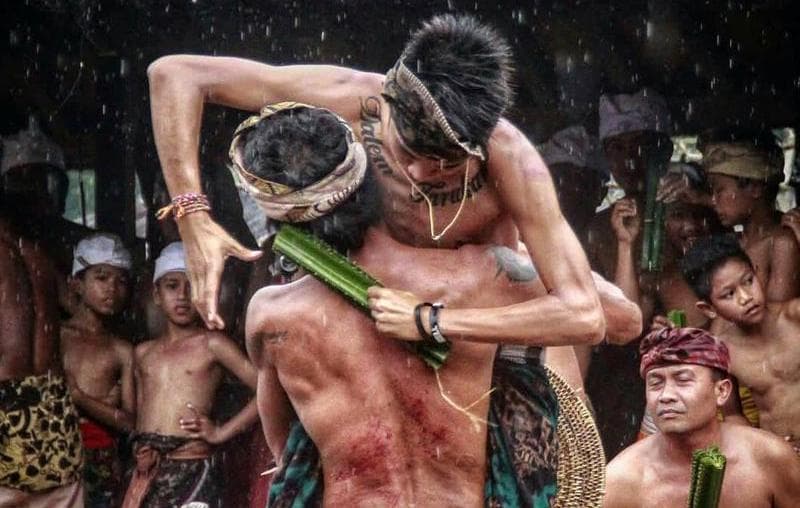
The pandan war is the high point of Usaba Sambah, a month-long festival in the fifth month of Tenganan’s own calendar. Young men and boys as young as seven fight bare-chested in pairs with bundles of 10 to 15 thorny pandan leaves and rattan shields, to the sound of the sacred selunding gamelan. The blood drawn is an offering to Indra. Bouts are short and end in an embrace, and wounds are dressed with a paste of turmeric, galangal and other roots.
- 05
Ritual swings and the festival days
During Usaba Sambah, unmarried young women in their finest geringsing sit on old wooden ritual swings that the young men turn, a rite tied to the cycle of life. The fights take place over two days, starting around midday with a procession. Fights were reported on 5 June 2024, and they were part of the culture festivals held from 21 to 23 June 2025 and 9 to 11 June 2026. The 2026 Tenganan Pegringsingan Culture Festival was listed on the provincial Love Bali portal and free to attend.
- 06
Gamelan selunding
Tenganan’s sacred orchestra, the selunding, is played on iron-keyed metallophones, unlike the bronze gamelan heard across most of Bali. It belongs to the village’s ritual life rather than to tourism: it sounds at ceremonies and marks the start of the pandan fights. If you visit during a ceremony and hear it playing, keep a respectful distance and let villagers pass.
- 07
The Kastala walk into the village
The best way to arrive is on foot from Kastala, an old farming village across the valley to the north. The path crosses a bamboo bridge, climbs to the ridge past rice terraces and subak channels, follows the forested rim and drops to Tenganan’s northernmost temple, by an old banyan tree. Allow about two hours at an easy pace, with Agung and Lempuyang in view on clear mornings. Paths are easy to lose, so hire a local guide.
Seasons
Best time to visit Tenganan Pegringsingan Village.
Come in the morning, when it is cooler and weavers are more likely to be at their looms. Tenganan is rarely crowded: on a weekday in September 2025 a reporter met only about a dozen other visitors. Midday is the hottest time to be out on the open stone paving.
April to October is dry and the best time for the Kastala walk; September is usually the driest month. From November to March, afternoon storms are common and the stone paving gets slick, so visit early and keep the walk for a clear morning.
Usaba Sambah runs for a month from the fifth day of the village’s fifth month, which usually falls in June. The 2026 Tenganan Pegringsingan Culture Festival ran from 9 to 11 June; the 2027 dates had not been announced as of November 2026. On big ceremony days some houses and stalls close, although visitors may still walk through. On Nyepi, 8 March 2027, all of Bali stays indoors and no visits are possible.
Coming between November and March? Read our Bali rainy season guide →
Getting There
How to get to Tenganan Pegringsingan Village.
| From | Time | How |
|---|---|---|
| Candidasa | 10 min by car; 45–60 min on foot | About 4.5 km. The village road turns inland off the coast road about 1 km west of central Candidasa and climbs gently through rice fields to the parking area at the southern gate. Walking is possible, but the road is narrow, unshaded and shared with traffic. |
| Padang Bai | 20–30 min | About 15 km by car or scooter east along the coast road, then up the village road. An easy stop before or after a boat to the Gilis or Lombok. |
| Bali airport (DPS) | 1.5–2.5 hours | About 67 km by car, mostly on the coast road past Padang Bai. Book a driver; most visitors come as part of an East Bali day trip. |
| Ubud | 1.5–2 hours | About 48 km by car via Klungkung. Pair it with Goa Lawah and Candidasa, or with Tirta Gangga and Taman Ujung. |
| Sanur | 1.25–2 hours | About 52 km by car along the east-coast road, the quickest of the southern beach bases. |
| Seminyak or Canggu | 1.75–2.5 hours | About 62 km by car. A long day out; start by 8 AM to see the village before the midday heat. |
| Amed | 45–60 min | About 38 km by car via Amlapura, passing Tirta Gangga on the way. |
Getting around Tenganan Pegringsingan Village
Cars and scooters stop at the parking area outside the southern gate. Just past it you sign the guest book and leave your donation at the desk, and from there everything is on foot. The concourse is paved in stone and climbs in low terraces with a few steps between them, manageable for most people but slippery after rain.
Grab and Gojek can drop you off, but pickups this far east are unreliable, so ask your driver to wait or ride a scooter from your hotel. Villagers sometimes offer to walk you around. It is a useful way to learn who lives where and what you may enter; a tip is expected, so agree on the amount before you set off.
The village keeps daylight hours, roughly 8 AM to 6 PM, and outsiders cannot stay overnight. If you are walking up from Candidasa, leave time to get back down before dark: the road has no sidewalk and few lights.
Know Before You Go
Tenganan Pegringsingan Village tips that save time and trouble.
- 01Carry cash in small bills for the donation; about IDR 50,000 per person is typical, and it goes to the village.
- 02Dress modestly, with shoulders and knees covered. You do not need a sarong for the lanes, but bring one if a ceremony is on.
- 03Ask before photographing people, especially weavers and children, and never walk into a compound or temple uninvited.
- 04Do not climb or sit on pavilions in ritual use, and keep clear of offerings on the ground.
- 05Genuine double-ikat geringsing costs millions of rupiah. Before you buy, ask whether a cloth is double or single ikat and who wove it.
- 06Look at several prasi panels before buying; the same designs turn up in different houses at different prices.
- 07For the Perang Pandan, arrive by late morning and stand well back from the fighting area, where thorny leaves fly.
- 08Hire a local guide for the Kastala walk and start early, before the heat.
- 09Leave before dusk; the village is closed to visitors after dark.
FAQ
Tenganan Pegringsingan Village questions, answered.
Is Tenganan village worth visiting?
Yes, if you are interested in Balinese culture, textiles or village life. It is one of the few places where you can see geringsing double ikat made and a Bali Aga village laid out much as it has been for centuries. It is a quiet, one- to two-hour walk, not a staged attraction, so plan it with Candidasa, Tirta Gangga or Taman Ujung.
How much is the entrance fee to Tenganan?
There is no fixed ticket. You sign the guest book and leave a donation at the desk past the parking area; the village sets no amount, and about IDR 50,000 per person is typical (checked Nov 2026). A local guide told one reporter that donations go to the village fund. Bring cash in small bills.
What are the opening hours of Tenganan Pegringsingan?
Daily from about 8 AM to 6 PM (checked Nov 2026). Some guides list a 7 AM opening and one 2025 report gave 6:30 PM, but the village is closed to visitors after dark and outsiders cannot stay overnight. Mornings are cooler and the best time to find weavers at work.
When is the Perang Pandan in Tenganan?
Usually in June, during Usaba Sambah, a month-long festival that starts on the fifth day of the fifth month of Tenganan’s calendar. Fights were reported on 5 June 2024, and they were part of the culture festivals held from 21 to 23 June 2025 and 9 to 11 June 2026. The 2027 dates were not announced as of November 2026. Watching is free.
What is geringsing cloth?
Geringsing is a cotton double ikat: both the warp and weft threads are tie-dyed before weaving, so the pattern forms on the loom. It is made only in Tenganan, Gujarat in India and Okinawa in Japan. Its name is read as “without illness,” and villagers use it in life-cycle rites from a child’s first hair-cutting to funerals.
How much does geringsing cost?
Real double ikat is expensive because a single length can take years to dye. In 2025 one Tenganan weaver asked about IDR 2.6 million for a small double-ikat cloth and IDR 5 million or more for a large one, while single-ikat pieces cost a few hundred thousand rupiah. Ask which technique a cloth uses before you buy.
What does Bali Aga mean?
Bali Aga, often translated as “original Balinese,” refers to communities whose customs predate the Majapahit influence that shaped most of Bali from the 14th century. Tenganan Pegringsingan is the best known. Its customary law, communal land, village layout and festival calendar differ from those of the lowland villages around it.
What should I wear to Tenganan?
Modest clothes that cover your shoulders and knees, and comfortable shoes for the stone paving. A sarong is not required to walk the village lanes, since visitors do not enter the temples, but bring one if you visit during a ceremony or the Perang Pandan. A hat and water help at midday.
Can I take photos in Tenganan?
Yes, of the lanes, gates and pavilions. Ask before photographing people, and ask weavers and artists before filming them at work. During ceremonies, follow the lead of the villagers running them and stay clear of processions. Do not step into compounds or temples for a better angle.
How do I get to Tenganan from Candidasa?
It is about 4.5 km, or 10 minutes by car or scooter, up a village road that leaves the coast road about 1 km west of central Candidasa. You can walk it in 45 to 60 minutes, uphill on the way there. From Ubud, allow 1.5 to 2 hours by car, and from the airport 1.5 to 2.5 hours.
Can you stay overnight in Tenganan?
No. Unlike some other villages in Bali, Tenganan Pegringsingan has no homestays, and outsiders cannot spend the night inside the village. The nearest places to stay are in Candidasa, 4.5 km down the hill, and along the coast at Mendira and Manggis.
Nearby
Where to go after Tenganan Pegringsingan Village.
Places close by that fit into the same trip, with realistic travel times.
10 min by car (4.5 km)
Candidasa lotus lagoon and Pura Candidasa
A temple to Shiva and the child-blessing goddess Hariti above a lotus pond in the center of town; prettiest at sunset.
20–25 min by car (13 km)
Virgin Beach (Pantai Pasir Putih)
The nearest white sand and calm water for a swim after the village, east of Bugbug.
25–30 min by car (17 km)
Taman Ujung Water Palace
The last Karangasem raja’s seaside water palace near Amlapura, with large ponds and bridges.
Visitor guide30–40 min by car (22 km)
Tirta Gangga water palace
Stepping stones, koi ponds and spring-fed pools among rice terraces.
Visitor guide25–30 min by car (19 km)
Goa Lawah bat cave temple
Shrines at the mouth of a cave full of bats, on the coast road toward Klungkung.
Visitor guide45–60 min by car (32 km)
Lempuyang Temple (Gates of Heaven)
The split gate framing Mount Agung; go at dawn and see Tenganan on the way back.
Visitor guide
More in Candidasa
Plan the rest of your time in Candidasa.
Read Next
More Tenganan Pegringsingan Village guides.
How we researched this
Sources and fact checks.
Prices, opening hours, show times and travel times in this Tenganan Pegringsingan Village guide were checked against official sites, government tourism pages and recent reporting on 9 November 2026. Where sources disagreed, we give the official figure and say so. Rankings are our editorial judgment, set out in our editorial policy.
We re-check the guide at least every three months and whenever we hear about a change. Spotted something out of date? Tell us.
Show all 20 sources ↓Hide sources ↑
- lovebali.baliprov.go.id/event/detail/1780621709478/tenganan-pegringsing…
- indonesia.travel/au-en/events/event-detail/tenganan-pegringsinga…
- indonesia.travel/id-id/tourism-village/desa-wisata-tenganan-pegr…
- detik.com/bali/wisata/d-8111395/menyusuri-desa-bali-aga-t…
- detik.com/bali/budaya/d-7964674/sia-siap-tenganan-pegring…
- detik.com/bali/budaya/d-7376485/masyarakat-wisatawan-antu…
- detik.com/bali/bisnis/d-7381677/seni-prasi-khas-tenganan-…
- kompas.tv/article/392904/wisata-budaya-desa-tenganan-pegr…
- tirto.id/turisme-massal-bali-bL9x
- mongabay.co.id/2016/07/13/melihat-aneka-ritual-kesadaran-lingk…
- thejakartapost.com/news/2014/09/04/creating-gringsing-a-study-pati…
- en.wikipedia.org/wiki/Tenganan
- id.wikipedia.org/wiki/Tenganan_Pegringsingan,_Karangasem
- en.wikipedia.org/wiki/Perang_pandan
- nowbali.co.id/mekare-kare-pandan-wars-tenganan-bali
- nowbali.co.id/trails-through-tenganan
- baliholidaysecrets.com/tenganan-village
- nominatim.openstreetmap.org
- thebaliguideline.com/blog/best-events-and-festivals-culture-in-bali
- thebaliguideline.com/blog/7-most-fascinating-place-in-east-bali