
Sidemen · Temple
Pura Besakih: A Visitor’s Guide to Bali’s Mother Temple
Bali’s holiest temple, 1,000 m up Mount Agung, and how to visit it without the hassle.
By The Bali Guideline Editorial TeamUpdated 16 October 2026
Overview
Pura Besakih, before you go.
Pura Besakih is the holiest temple in Balinese Hinduism, a complex of 23 temples terraced about 1,000 m up the south-west slope of Mount Agung, 18 to 24 km north of Sidemen. Since April 2024 one IDR 150,000 ticket covers a local guide, a sarong and the shuttle up. It is worth the trip on a clear morning for anyone curious about Balinese religion, less so in cloud or as a quick photo stop.
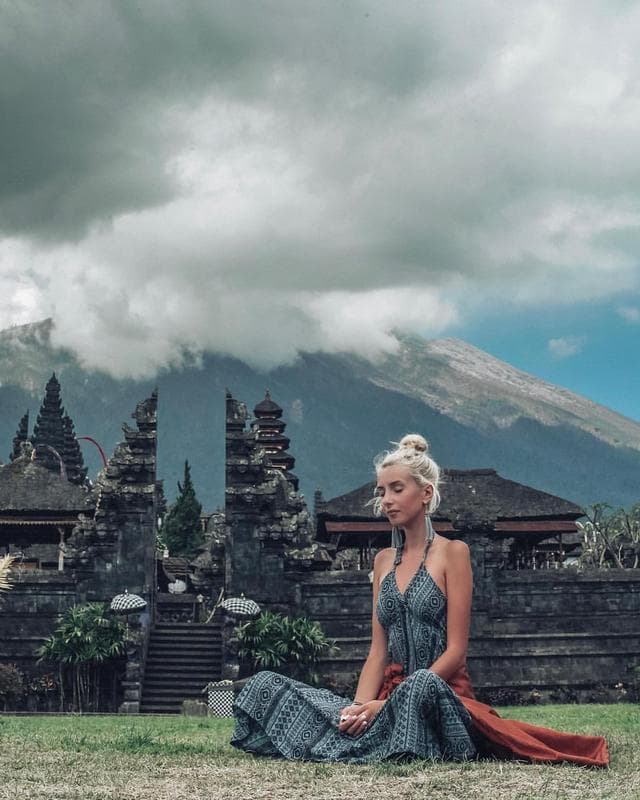
Pura Besakih is the mother temple of Balinese Hinduism, the one every Balinese family returns to. It stands about 1,000 m up the slope of Mount Agung, the island’s highest volcano. Wikipedia counts 23 temples on parallel ridges, terraced over six levels; the temple’s management lists 26, Pura Penataran Agung and 25 supporting temples. The stone terraces under Penataran Agung resemble megalithic stepped pyramids, so the ridge was probably sacred long before Hinduism arrived. Hindu worship here is recorded from 1284, and by the 15th century Besakih was the state temple of the Gelgel kings. An old palm-leaf text, the Lontar Padma Bhuana, calls it the head of the Balinese realm.
Balinese tradition places the beginning of their religion here, at Pura Basukian, where the sage Rsi Markandeya is said to have received his first revelation. In Penataran Agung, three lotus thrones, the Padma Tiga, are seats for three aspects of Siwa. Almost every shrine keeps its own anniversary on the 210-day Balinese calendar, so the complex holds at least 70 festivals a year. The biggest, Bhatara Turun Kabeh, the descent of all the gods, draws worshippers from every regency for three weeks after the full moon of the tenth Balinese month.
The mountain shapes the story. In 1963 Besakih was holding Eka Dasa Rudra, a purification rite meant to be performed once a century, when Agung began to erupt. Priests had disputed the date, but President Sukarno wanted the ceremony to go ahead. The eruption of 17 March killed more than 1,100 people, about 1,700 by some counts, and lava missed the temples by meters, which Balinese read as a sign from the gods. The rite was finally completed in 1979.
The visit itself changed in 2023. On 13 March that year President Joko Widodo opened a new terminal at Manik Mas, below the temples, with parking for more than 1,500 cars, kiosks and an audio-visual hall. You now buy one ticket at the office there, get a wristband, a sarong and an assigned local guide, and ride an electric shuttle up. The price has risen fast: IDR 60,000 plus IDR 30,000 for the shuttle in 2023, and IDR 150,000 for foreign adults since 1 April 2024.
Know the catches. Non-Hindus may not enter the inner courtyard of Penataran Agung, so you look through its gates rather than walk among the shrines. Cloud often hides Agung by late morning. Touts still work the edges, though far less than in the years of unofficial “guides” and inflated donation books that gave Besakih its reputation. Come early on a clear day, interested in what the place means, and few temple visits in Bali carry more weight.
- Opening hours
- Daily 7 am–6 pm for visitors; closed on Nyepi (checked Oct 2026)
- Ticket
- IDR 150,000 foreign adults, with guide, sarong, shuttle (checked Oct 2026)
- Time needed
- 1.5–2 hours, including the shuttle and the walk down
- Best time
- 7–9 am on a clear dry-season day; avoid Bhatara Turun Kabeh
- Dress code
- Sarong and sash included; cover shoulders and knees
- Location
- Mount Agung’s south-west slope, 18–24 km north of Sidemen
Besakih, Rendang, Karangasem Regency, Bali, Indonesia
Open in Google MapsWhat to See
What to see at Pura Besakih.
- 01
Arrival at the Manik Mas terminal
Every visit now starts at the terminal opened in 2023 below the temples, with multi-level parking, kiosks and toilets. Buy your ticket at the office beside the car park: you get a wristband, a sarong and sash, and a local guide. An electric shuttle then climbs the steep road in a few minutes. Your wristband is scanned again at the top, so keep it on until you leave.
- 02
Pura Penataran Agung and its stairway
The main temple climbs the ridge in terraces built on stone bases that resemble megalithic stepped pyramids. A long stairway rises to a split gate, and inside stand the Padma Tiga, three lotus thrones for Siwa, Sada Siwa and Parama Siwa, and rows of meru towers, the tallest with 11 roofs. Non-Hindus may not enter the inner courtyard; your guide will show you where to stand at the gates for the view.
- 03
The wider complex on the ridges
Besakih is less one temple than a village of them. The management lists Penataran Agung plus 25 supporting temples, among them Pura Gelap, Pura Batu Madeg, Pura Kiduling Kreteg and Pura Goa Raja, and one guide quoted in a 2025 visitor report counts at least 80 more private temples of clans and regencies. Paths and stairways link them across the slope, so wear shoes with grip and expect to climb.
- 04
Pura Basukian, where the religion began
Within the complex, Pura Basukian marks the place where, Balinese say, the sage Rsi Markandeya first received divine revelation, which is why it is treated as the starting point of Balinese Hinduism. It is smaller and quieter than Penataran Agung and worth asking your guide to include. As everywhere at Besakih, stay outside any courtyard where people are praying.
- 05
Mount Agung behind the meru
Agung’s 3,031 m summit lies about 7 km north-east of the temples, and on a clear morning it fills the sky behind the meru roofs. The 1963 eruption, which killed more than 1,100 people, sent lava past the complex by meters. Cloud usually builds by late morning, so the view is the strongest reason to arrive soon after the 7 am opening.
- 06
Ceremonies and daily worship
With at least 70 festivals a year, you have a fair chance of seeing one: families climbing the stairs with offerings, music in the pavilions, priests ringing bells and chanting. Watch from the side, never walk in front of people praying, and ask before photographing anyone. On big days the complex fills and the areas open to visitors shrink, which is part of the deal at a working temple.
- 07
Melukat, canang and film programs
The management sells add-ons beyond the standard ticket. A spiritual program of meditation, a short trek and melukat, a water purification rite, runs in two sessions, 8 am to 2 pm and 3 pm to 9 pm, for at least two people booked a day ahead, with temple dress, offerings, transport between three temples and food included. There is also a canang offering class and a documentary screening for groups of ten or more; the terminal has a 215-seat audio-visual hall, Wiyata Graha. Ask for prices through besakih.org.
Seasons
Best time to visit Pura Besakih.
Arrive at about 7 am, when visitors are first let in, or by 9 am. Tour groups build from about 10 am, and cloud often wraps Agung by late morning, taking away the view behind the meru. At 1,000 m the air is cooler than on the coast, and about 700 to 1,000 visitors a day were reported in 2024, spread across a large site.
May to September brings the clearest mornings and dry steps. From October to April, the wet season, afternoon downpours, mist and slippery stone are normal, so go even earlier. Check Mount Agung’s alert level on MAGMA Indonesia before any trip up the mountain.
Ceremonies matter more than season. Bhatara Turun Kabeh starts on the full moon of the tenth Balinese month and runs for 21 days; in 2026 it ran from 2 to 23 April, and the next is expected in late March 2027, about two weeks after Nyepi on 8 March. Expect huge crowds, shuttles reserved for worshippers and fewer areas open to visitors. Galungan, next on 13 January 2027, and Kuningan ten days later also fill the temples. On Nyepi Besakih is closed to everyone.
Getting There
How to get to Pura Besakih.
| From | Time | How |
|---|---|---|
| Sidemen | 30–45 min | About 18 km from the village market or 24 km from the Tabola road, by car or scooter through Sangkan Gunung and north on the Rendang road. Many Sidemen hotels arrange a driver for the morning. |
| Ubud | 1.25–1.75 hours | About 44 km by car through Bedulu, Gianyar and Semarapura (Klungkung), then 22 km north up the Besakih road. Leave by 7 am to beat the cloud and the tour groups. |
| Candidasa | 1–1.5 hours | About 45–48 km by car west along the coast road to Klungkung, then north. Pair it with Kertha Gosa or a night in Sidemen on the way back. |
| Kintamani (Penelokan) | 30–45 min | About 18 km down the winding mountain road from the caldera rim. It works after a Mount Batur sunrise trek if you still have the legs for the stairs. |
| Bali airport (DPS) | 1.75–2.5 hours | About 66 km by car on the Ida Bagus Mantra coast bypass to Klungkung, then north. Pre-book a driver; there is no useful public transport. |
| Seminyak or Canggu | 2–3 hours | About 61–63 km by car. Leave by 6:30 am to clear South Bali’s traffic and reach the temple before the cloud. |
| Sanur | 1.5–2 hours | About 51 km by car on the coast bypass, the closest of the southern bases. |
Getting around Pura Besakih
Drive to the Manik Mas terminal. Its lots hold 1,541 cars and 1,268 motorbikes, with buses and trucks sent to a separate area at Kedungdung. Parking was IDR 10,000 for a car and IDR 5,000 for a scooter in 2025 and 2026 reports, cash only. Ignore anyone on the approach road who waves you into a private lot farther down; the ticket office is next to the official car park.
The electric shuttle included in your ticket runs one way, up to the forecourt below the temples. Walking back down takes 10 to 15 minutes, or the return ride costs IDR 20,000. Above the drop-off you walk and climb: the stairway to Penataran Agung is long and steep, and the stone gets slippery after rain. During big ceremonies, buggies are kept for priests, the elderly, pregnant women and people with disabilities.
There is no public transport. A car with driver for the day is the usual way, and lets you add Kertha Gosa, Sidemen or Goa Lawah. Grab and Gojek may drop you off, but few drivers wait up here for a ride back, so keep your driver. On a scooter, the road north from Klungkung is paved but winding; avoid it after dark.
Know Before You Go
Pura Besakih tips that save time and trouble.
- 01Buy your ticket only at the official office by the Manik Mas car park. The guide is included, so do not pay anyone on the road for one.
- 02Ignore anyone outside the office who says the temple is closed for a ceremony and offers a back entrance for a fee.
- 03Offerings are not required. Women at the shuttle drop-off may say one is essential; a polite no is enough.
- 04Mirror-reflection photos near the main stairway cost about IDR 30,000 each (reported January 2026). They are optional.
- 05A tip for your guide is optional; recent visitor reports suggest about IDR 40,000 to 50,000.
- 06Carry cash for parking, the return shuttle and tips. The ticket office has taken cards as well as cash.
- 07Wear shoes with grip and bring a light rain jacket; the steps are steep and the weather turns fast at 1,000 m.
- 08By Balinese custom, women who are menstruating may not enter the inner temple areas.
- 09Do not fly a drone over the complex, and never walk in front of people at prayer.
FAQ
Pura Besakih questions, answered.
How much is the Besakih entrance fee?
IDR 150,000 for foreign adults and IDR 80,000 for Indonesian visitors, in force since 1 April 2024 (checked Oct 2026). It covers a local guide, a sarong and sash, a one-way electric shuttle and toilets. In 2023 foreigners paid IDR 60,000 plus IDR 30,000 for the shuttle. Parking and the return shuttle, IDR 20,000, are extra.
What are Besakih’s opening hours?
Daily from 7 am to 6 pm for visitors, according to Indonesia’s tourism board (checked Oct 2026); worshippers can come at any hour. Some guides list 8 am, so do not count on earlier entry. Besakih closes to everyone on Nyepi, next on 8 March 2027, and visitor access is limited during Bhatara Turun Kabeh.
Do you need a guide at Besakih?
Yes, but you do not pay extra for one. The ticket includes a local guide, assigned at the office, and the rules say visitors must stay with their guide inside the sacred area. A tip is optional. Anyone selling guide services on the approach road or in a private car park is not part of the official system.
Is there a guide scam at Besakih?
The old one, unofficial guides and inflated donation books, is far rarer since the 2023 ticket office opened, by recent visitor reports. What remains: people outside the office claiming the temple is closed and offering a back way in, sellers insisting an offering is compulsory, paid mirror photos, and guides who steer you to shops. Pay only at the office and decline politely.
Can tourists go inside Besakih temple?
Yes, into the complex, its outer courtyards and the stairways between temples, wearing the sarong included in the ticket and with your guide. Non-Hindus may not enter the inner courtyard of Pura Penataran Agung and view it through the gates. During big ceremonies the areas open to visitors shrink further.
Is Besakih worth visiting?
Yes, on a clear morning, if Balinese religion interests you: no other temple matters more to the Balinese, and Agung rising behind the meru is a sight in itself. It is less worth it in cloud, if you expect to walk into the inner shrines, or as a 20-minute photo stop after a two-hour drive.
What should I wear to Besakih?
Clothes that cover your shoulders and knees. A sarong and sash are included in the ticket and handed back at the end, so you do not need to buy one in the car park. Wear shoes with grip for the steep stone steps and bring a light jacket for rain at 1,000 m.
When is Bhatara Turun Kabeh at Besakih?
Every year from the full moon of the tenth Balinese month, for about 21 days. In 2026 it ran from 2 to 23 April; the next is expected in late March 2027. Worshippers come from across Bali in their regency’s turn, shuttles go to them first, and visitor access is limited, so plan around it unless you want the ceremony.
How far is Besakih from Ubud?
About 44 km, or 1.25 to 1.75 hours by car through Gianyar and Klungkung. From Sidemen it takes 30 to 45 minutes, from Kintamani 30 to 45 minutes and from Seminyak or Canggu 2 to 3 hours, so many visitors combine it with a night in Sidemen.
Did the 1963 eruption damage Besakih?
Barely. Mount Agung’s 1963 eruption killed more than 1,100 people, about 1,700 by some counts, while Besakih was holding the once-a-century Eka Dasa Rudra rite. Lava missed the temples by meters, which Balinese took as a sign from the gods. The ceremony was finally completed in 1979.
How long do you need at Besakih?
About 1.5 to 2 hours: buying the ticket, the shuttle, a guided walk to Penataran Agung and nearby temples, and the 10 to 15-minute walk down. Add an hour if you want to explore the outer temples on the ridges, or book the melukat program.
Can you climb Mount Agung from Besakih?
Yes, with a licensed local guide, compulsory since January 2025. The Besakih route reaches the true summit and takes about 10 to 14 hours return, usually starting around midnight. Climbs stop in bad weather and during big ceremonies at the mountain’s temples, so check before you book.
Nearby
Where to go after Pura Besakih.
Places close by that fit into the same trip, with honest travel times.
30–45 min by car (18–24 km)
Sidemen rice valley
Terrace walks, songket looms and Agung views, and the best base for an early start at Besakih.
30–40 min by car (22 km)
Kertha Gosa, Semarapura
The late-18th-century court pavilion of the Klungkung kings, with a painted ceiling and a floating pavilion; IDR 50,000 for foreign adults.
30–45 min by car to Penelokan (18 km)
Kintamani and Mount Batur
The caldera rim, Lake Batur and the sunrise trek up an active volcano.
Visitor guide45–60 min by car (31 km)
Goa Lawah bat cave temple
A sea temple whose shrines stand at the mouth of a cave packed with bats, on the coast road toward Padang Bai.
1–1.25 hours by car (34 km)
Tirta Gangga
The water garden the last raja of Karangasem built in 1946, with koi ponds, stepping stones and a spring-fed pool.
Visitor guide1.25–1.5 hours by car (44 km)
Lempuyang temple
The split gate that frames Agung from the east side of the mountain; expect a long queue for the photo.
Visitor guide
More in Sidemen
Plan the rest of your time in Sidemen.
Read Next
More Pura Besakih guides.

How we researched this
Sources and fact checks.
Prices, opening hours, show times and travel times in this Pura Besakih guide were checked against official sites, government tourism pages and recent reporting on 16 October 2026. Where sources disagreed, we give the official figure and say so. Rankings are our editorial judgment, set out in our editorial policy.
We re-check the guide at least every three months and whenever we hear about a change. Spotted something out of date? Tell us.
Show all 22 sources ↓Hide sources ↑
- indonesia.travel/id-id/travel-ideas/pilgrimage/pura-besakih/%20(…
- besakih.org/%20(temple%20management%20site:%20guide%20rule,…
- balipost.com/news/2024/01/30/385652/Akan-Naikkan-Harga-Tiket…
- detik.com/bali/wisata/d-7250448/dear-wisatawan-tiket-masu…
- detik.com/bali/wisata/d-6804401/pengunjung-pura-besakih-a…
- balipost.com/news/2026/03/14/535468/Ida-Bhatara-Turun-Kabeh-…
- baliprov.go.id/web/shuttle-bus-permudah-akses-pemedek-di-pura-…
- detik.com/bali/budaya/d-7861663/15-kendaraan-shuttle-disi…
- journal.unj.ac.id/unj/index.php/logistik/article/view/44758%20(Ma…
- en.wikipedia.org/wiki/Besakih_Temple%20(coordinates%20-8.374368,…
- id.wikipedia.org/wiki/Pura_Besakih%20(26%20temples,%20Padma%20Ti…
- en.wikipedia.org/wiki/Mount_Agung%20(3,031%20m,%20summit%20coord…
- en.wikivoyage.org/wiki/Besakih%20(Eka%20Dasa%20Rudra%201963%20and…
- baliuntold.com/things-to-do/temples/pura-besakih/%20(Sept%2020…
- baliholidaysecrets.com/besakih-temple/%20(Jan%202026:%20mirror%20photo…
- pura-besakih.com/hours-and-fees/%20(unofficial:%20closed-for-cer…
- jonnymelon.com/besakih-temple-bali/%20(Feb%202026:%20guide%20t…
- kura2bus.com/blog/besakih-temple-announces-visitor-guideline…
- detik.com/bali/wisata/d-7727198/perhatian-pendaki-gunung-…
- magma.esdm.go.id
- router.project-osrm.org/%20(road%20distances%20from%20Sidemen,%20Ubud,%…
- thebaliguideline.com/blog/must-see-temples-in-bali%20(hero%20photo%2…