
Tabanan · Temple
Pura Taman Ayun: A Visitor’s Guide to Mengwi’s Royal Water Temple
Mengwi’s moated royal temple, one of Bali’s five UNESCO subak sites.
By The Bali Guideline Editorial TeamUpdated 16 October 2026
Overview
Pura Taman Ayun, before you go.
Pura Taman Ayun is the moated royal temple of the old Mengwi kingdom, in Mengwi town in Badung regency, not Tabanan, though it lies on the road to Jatiluwih and Tanah Lot. It is one of Bali’s five UNESCO subak sites. You walk its gardens and see the tiered meru over the inner wall. It is worth 45 minutes on a day trip north, not a journey of its own.
Pura Taman Ayun, the “beautiful garden” temple, is the family temple of the royal house of Mengwi, the kingdom that once ruled this part of Bali. Badung regency and Balinese tradition date it to 1634 (Saka 1556) and credit I Gusti Agung Putu, the first king of Mengwi, later called Cokorda Sakti Blambangan. Historians are less sure. UNESCO’s advisers describe it as built as a royal temple in the early 18th century, when Mengwi was rising, and the historian Henk Schulte Nordholt records a renovation in 1750. Mengwi grew into one of Bali’s strongest kingdoms until Badung conquered it in 1891. The temple survived, and the royal house still owns and runs it.
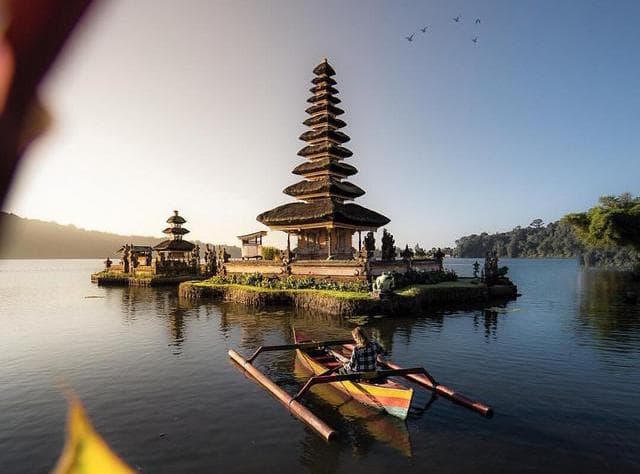
Two things make it matter to Balinese. In the inner courtyard the Mengwi dynasty honors its deified ancestors in the Gedong Paibon, and the gods in rows of meru, the tiered shrines whose roofs rise to eleven levels. The water matters as much as the shrines. In 2012 UNESCO listed Taman Ayun as one of five sites in Bali’s subak cultural landscape, calling it the largest and most architecturally distinguished regional water temple on the island. Holy water from the mountain lakes is collected here and passed on to subak farmer groups downstream, and the moat itself supplies the small subak of Batan Badung.
The visit is a garden walk more than a temple visit. You cross a bridge over the moat into a lawn with a fountain, pass the old cockfighting pavilion, enter a middle courtyard with a drum tower, then follow a path around the outside of the inner sanctuary’s wall. The sanctuary, ringed by its own narrow moat, is for worshippers; you see its 29 shrines and altars from outside. That is the main catch. People who expect to walk among the meru leave disappointed, and the whole loop takes well under an hour.
Some things have changed. Since 1 January 2026 Badung regency charges foreign adults IDR 50,000, so older guides quoting IDR 15,000 to 30,000 are out of date. On 7 July 2025 the head of the royal house, former Badung regent Anak Agung Gde Agung, was consecrated as the 13th Cokorda of Mengwi in a ceremony here, and the wantilan now hosts an annual Barong festival. Taman Ayun is also the easiest of the five UNESCO sites to reach from the south coast, 40 to 60 minutes from Canggu, and the meru skyline above the moat is worth the stop.
- Opening hours
- Daily about 8 am–6:15 pm (checked Oct 2026)
- Ticket
- IDR 50,000 foreign adults, IDR 25,000 children (checked Oct 2026)
- Time needed
- 45 minutes to 1 hour; add 30 minutes for the museums next door
- Best time
- At the 8 am opening or after 4 pm, on a weekday
- Dress code
- Shoulders and knees covered; sarong lent at the gate
- Location
- Mengwi, Badung regency; 40–60 min from Canggu
Jl. Ayodya No.10, Mengwi, Badung Regency, Bali 80351, Indonesia
Open in Google MapsWhat to See
What to see at Pura Taman Ayun.
- 01
The moat and the bridge
A wide pond planted with lotus wraps the compound on the west, south and east, and the way in is a single bridge on the south side. Walk along the water before you cross: the meru roofs rise above the walls, and this is where the wide photos of the temple come from. Local anglers fish from the bank, and on public holidays local families fill the shady garden around it.
- 02
The garden courtyard and the wantilan
Past the gate, the first courtyard is a flat lawn with fruit and flowering trees and a fountain whose spouts point to the nine directions of the Balinese compass. On the right stands the wantilan, a large open pavilion built for cockfights and now used for gatherings, gamelan and dance. A wing beside it has held a small gallery of old photographs and the royal family’s account of the temple; ask at the gate whether it is open.
- 03
The middle courtyard
A split gate leads up into the jaba tengah, the middle courtyard. In its west corner stands the bale kulkul, the drum tower whose wooden slit drums call the congregation to ceremonies. A pavilion here carries carved reliefs of the Dewata Nawa Sanga, the nine gods who guard the points of the compass, and it is worth a slow look before you walk on toward the inner wall.
- 04
The meru over the inner wall
The jeroan, the highest and holiest courtyard, sits inside its own narrow moat, and its gates are closed to visitors. A paved path loops around the outside of its wall, and from it you look across at the 29 shrines and altars UNESCO’s evaluators counted inside: rows of meru from two up to eleven tiers, a padmasana throne for the supreme god, and the Gedong Paibon for the Mengwi ancestors. Walk the full loop; each side shows a different line of roofs.
- 05
A water temple in the subak system
Taman Ayun is the lowland piece of the UNESCO listing. The other four sites, Lake Batur, Pura Ulun Danu Batur, the Pakerisan valley and the Batukaru terraces around Jatiluwih, sit in the hills. UNESCO’s evaluators describe Taman Ayun as part of a ritual water system that spans whole rivers, where holy water from the lakes passes to subaks downstream. Seeing it on the same day as Jatiluwih makes the idea easier to grasp.
- 06
Barong festival and the holiday market
A few days a year Taman Ayun becomes a local event. The annual Taman Ayun Barong Festival fills the wantilan with Barong dancers and solo drummers, including a children’s competition; the 2025 edition ran on 27–28 September, and the 2026 edition is set for 6–7 November from 1 pm. Around Galungan, Kuningan, the day after Nyepi and New Year, hundreds of stalls form a pop-up market in front of the temple, busiest from late afternoon.
- 07
Ogoh-Ogoh and Yadnya museums
Two small museums sit just off the south-west corner of the compound. The Ogoh-Ogoh Bali Museum on Jl. Ayodya shows the giant demon figures that every village parades on the eve of Nyepi, and Museum Yadnya on Jl. Wasista displays replicas of Balinese Hindu ceremonies and their offerings. Both are a few minutes’ walk from the temple, and they explain much of what you see in the courtyards. Check hours and fees at each door.
Seasons
Best time to visit Pura Taman Ayun.
Come at opening, about 8 am, or after 4 pm. Morning visits beat the tour vans that stop here on the way to Bedugul and Jatiluwih, and late afternoon is calm again once most groups have left, with low light on the moat and the meru. Much of the path is shaded, so midday is bearable, but Mengwi sits on the hot lowland plain, so bring water.
Indonesian long weekends bring domestic crowds; detikBali found the grounds busy from morning to evening on the Waisak weekend of May 2025. Around Galungan and Kuningan, next on 13 and 23 January 2027, local families fill the garden and the pop-up market in front, which is lively but not quiet. On Nyepi, 8 March 2027, the whole island stays home and nobody travels. The 2026 Barong festival, on 6–7 November, is the best chance to see the wantilan in use.
Season matters less here than in the hills. The dry months from April to October give clearer skies for the drive on to Jatiluwih or Bedugul, while wet-season afternoons from November to March often bring heavy rain, so visit in the morning and save the hills for later.
Getting There
How to get to Pura Taman Ayun.
| From | Time | How |
|---|---|---|
| Canggu | 40–60 min (about 19 km) | Car or scooter inland through Padonan and Dalung to the main Denpasar–Gilimanuk road, then north through Kapal. Leave by 7:15 am to be at the gate for the 8 am opening. |
| Seminyak | 45–75 min (about 21 km) | Car with driver or Grab via Kerobokan and Padang Luwih, then Kapal. Morning traffic in Kerobokan decides the time. |
| Ubud | 40–60 min (about 17 km) | Car with driver west on village roads through Mambal and Gulingan. A good first stop on a day toward Bedugul or Jatiluwih. |
| Ngurah Rai Airport (DPS) | 1–1.5 hours (about 30 km) | Pre-booked car through Denpasar and Kapal. Worth it only as a stop on the way to an Ubud, Bedugul or Tabanan stay. |
| Sanur | 50–75 min (about 26 km) | Car with driver across Denpasar; avoid the 4–7 pm rush on the way back. |
| Uluwatu or Nusa Dua | 1.5–2.5 hours (about 47 km) | Car with driver past the airport and through Denpasar. Only sensible as part of a full day that ends at Tanah Lot. |
| Tanah Lot | 35–50 min (about 18 km) | Car with driver, about 18 km east. Many tours pair the two, with Taman Ayun first and Tanah Lot for sunset. |
Getting around Pura Taman Ayun
Cars and scooters park in the lot by the entrance on Jl. Ayodya; a 2026 report puts parking at about IDR 5,000 for a car and IDR 2,000 for a scooter, paid in cash. From the ticket booth you walk straight across the bridge. Paths inside are flat and paved, with a few steps through the gates, and much of the loop is shaded. The Google listing marks the entrance as not wheelchair-accessible, so call ahead if you need step-free access.
Most visitors come with a driver hired for the day, because Taman Ayun works best as one stop among several. Grab and Gojek will drop you in Mengwi easily, and the town sits on the main road, but for the onward drive to Jatiluwih, Bedugul or Alas Kedaton keep your driver, as app rides into the hills are hard to find. On a scooter, the main road through Kapal carries heavy trucks heading west.
You do not need a guide, and there is little explanation on site. Read the history before you go, or use a driver-guide who knows the courtyards. Pay at the booth in cash; a 2026 report says the card machine is not always working.
Know Before You Go
Pura Taman Ayun tips that save time and trouble.
- 01Carry cash in small notes for the ticket, parking and the museums next door.
- 02Wear clothes that cover your shoulders and knees; a sarong is lent with the ticket.
- 03Keep to the paths and do not climb the walls or shrines for a better photo.
- 04Walk the whole loop around the inner wall; each side shows a different row of meru.
- 05Start your photos from the moat bank before you cross the bridge, when the light is low.
- 06If a ceremony is on, stay out of the way of worshippers and their offerings.
- 07Pair it with Jatiluwih on the same day; the two UNESCO sites explain each other.
- 08Ignore older blogs quoting IDR 15,000 to 30,000; the price rose in January 2026.
FAQ
Pura Taman Ayun questions, answered.
How much is the Taman Ayun entrance fee?
IDR 50,000 for foreign adults and IDR 25,000 for foreign children, or IDR 25,000 and IDR 15,000 for Indonesians (checked Oct 2026). Badung regency set these rates from 1 January 2026, so older guides quoting IDR 15,000 to 30,000 are out of date. A 2026 report says the ticket includes the loan of a sarong. Pay in cash, and add a few thousand rupiah for parking.
What are Taman Ayun’s opening hours?
Daily from about 8 am to 6:15 pm (checked Oct 2026). The Google listing and a detikBali guide give 8 am to 6:15 pm, while a 2026 travel guide says 6 pm, so plan to arrive before 5:30 pm. Ceremonies can limit where visitors may walk, but the grounds normally stay open every day.
Is Taman Ayun worth visiting?
Yes, as a 45-minute stop on the way to Jatiluwih, Bedugul or Tanah Lot. The moat, the gardens and the rows of meru are among the finest temple architecture in Bali, and it is one of five UNESCO subak sites. It is not worth a long trip on its own, because you cannot enter the inner courtyard and there is little explanation on site.
Where is Taman Ayun? Is it in Tabanan?
It is in Mengwi town, in Badung regency, at Jl. Ayodya No.10, about 19 km north of Denpasar. It is not in Tabanan, but it sits on the road from the south toward Tabanan’s Jatiluwih terraces and is 35 to 50 minutes from Tanah Lot, so it often appears on Tabanan tours and in our Tabanan guide.
Can you go inside Taman Ayun temple?
Partly. Visitors may cross the moat and walk the outer garden courtyard and the middle courtyard, then follow a path around the outside of the inner sanctuary. The inner courtyard, with the meru and the royal ancestor shrines, is for worshippers only, and its gates are closed to visitors. You see the shrines from the path outside its wall.
When was Taman Ayun built?
Badung regency and Balinese tradition say 1634, or Saka 1556, by I Gusti Agung Putu, the first king of Mengwi. UNESCO’s advisers place its building as a royal temple in the early 18th century, and the historian Henk Schulte Nordholt records a renovation in 1750. It has been restored several times since, with a major restoration in the 1930s.
Why is Taman Ayun a UNESCO World Heritage Site?
Because it is part of the subak system. In 2012 UNESCO listed it as one of five sites in the Cultural Landscape of Bali Province, with Jatiluwih’s Batukaru terraces, the Pakerisan valley, Lake Batur and Pura Ulun Danu Batur. UNESCO calls it the largest and most architecturally distinguished regional water temple, linking the Mengwi kings to the farmers’ water system.
How long do you need at Taman Ayun?
About 45 minutes to an hour to cross the moat, see the two open courtyards and walk the loop around the inner wall. Add half an hour if you visit the Ogoh-Ogoh and Yadnya museums next door. Plan 40 to 60 minutes each way from Canggu or Ubud, or treat it as a stop on a longer driving day.
What should I wear to Taman Ayun?
Clothes that cover your shoulders and knees, as at any Balinese temple. A 2026 report says a sarong is lent at the entrance and included in the ticket, so you do not need your own. Flat shoes are fine, since the paths are paved and level. Bring a hat and water for the open lawn.
Can you visit Taman Ayun, Jatiluwih and Tanah Lot in one day?
Yes, with a driver and an early start. Leave Canggu by 7:15 am, see Taman Ayun at opening, drive 1 to 1.5 hours to Jatiluwih for the terraces and lunch, then 1.25 to 1.75 hours down to Tanah Lot for a falling tide and sunset. Alas Kedaton fits between Taman Ayun and Jatiluwih if you start even earlier.
Nearby
Where to go after Pura Taman Ayun.
Places close by that fit into the same trip, with honest travel times.
2–5 min on foot
Ogoh-Ogoh Bali Museum and Museum Yadnya
Nyepi demon figures and replicas of Balinese ceremonies, just off the south-west corner of the temple.
15–20 min by car (about 8 km)
Alas Kedaton
A forest temple at Kukuh with about 2,000 macaques and fruit bats, on the way to Jatiluwih.
20–30 min by car (about 13 km)
Margarana memorial
The 1946 battlefield where I Gusti Ngurah Rai and his men died, with 1,372 stone markers.
35–50 min by car (about 18 km)
Tanah Lot
The sea temple on a rock in the surf, best at a falling tide in the late afternoon.
Visitor guide1–1.5 hours by car (about 38 km)
Jatiluwih Rice Terraces
Part of the Batukaru subak landscape in the same UNESCO listing, with waymarked walks through red rice.
Visitor guide1–1.25 hours by car (about 34 km)
Pura Ulun Danu Beratan
The lake temple at Bedugul, up the same main road north from Mengwi.
Visitor guide
More in Tabanan
Plan the rest of your time in Tabanan.
Read Next
More Pura Taman Ayun guides.

How we researched this
Sources and fact checks.
Prices, opening hours, show times and travel times in this Pura Taman Ayun guide were checked against official sites, government tourism pages and recent reporting on 16 October 2026. Where sources disagreed, we give the official figure and say so. Rankings are our editorial judgment, set out in our editorial policy.
We re-check the guide at least every three months and whenever we hear about a change. Spotted something out of date? Tell us.
Show all 23 sources ↓Hide sources ↑
- detik.com/bali/wisata/d-8307974/rincian-tarif-baru-4-obje…
- whc.unesco.org/en/list/1194
- whc.unesco.org/archive/advisory_body_evaluation/1194rev.pdf%20…
- sita.badungkab.go.id/en/destinations/taman-ayun-temple-historical-re…
- indonesia.travel/gb-en/destination/bali-nusa-tenggara/bali/pura-…
- detik.com/bali/berita/d-8708554/taman-ayun-barong-festiva…
- detik.com/bali/budaya/d-8134640/antusiasnya-anak-anak-men…
- detik.com/bali/berita/d-7999589/sejarah-singkat-kerajaan-…
- detik.com/bali/wisata/d-7884116/umanis-galungan-pasar-dad…
- detik.com/bali/wisata/d-7910246/long-weekend-waisak-wisdo…
- detik.com/bali/wisata/d-6602713/pesona-pura-taman-ayun-se…
- en.wikipedia.org/wiki/Pura_Taman_Ayun%20(coordinates)
- id.wikipedia.org/wiki/Pura_Taman_Ayun
- en.wikipedia.org/wiki/Kingdom_of_Mengwi
- nowbali.co.id/pura-taman-ayun-temple-mengwi-bali
- baliholidaysecrets.com/taman-ayun-temple
- photodharma.net/Indonesia/70-Taman-Ayun-Temple/index.htm
- bali.com/places/taman-ayun-temple
- tamanayunbali.com/%20(unofficial;%20Google%20listing%20hours%20an…
- setneg.go.id/baca/index/inilah_skb_3_menteri_libur_nasional_…
- https://router.project-osrm.org (road distances to Canggu, Seminyak, Ubud, the airport, Sanur, Uluwatu, Tanah Lot, Jatiluwih, Alas Kedaton, Margarana, Lake Beratan)
- thebaliguideline.com/blog/must-see-temples-in-bali
- thebaliguideline.com/blog/best-day-trips-from-seminyak