
Tabanan · Nature
Jatiluwih Rice Terraces: Walking Bali’s UNESCO Subak Landscape
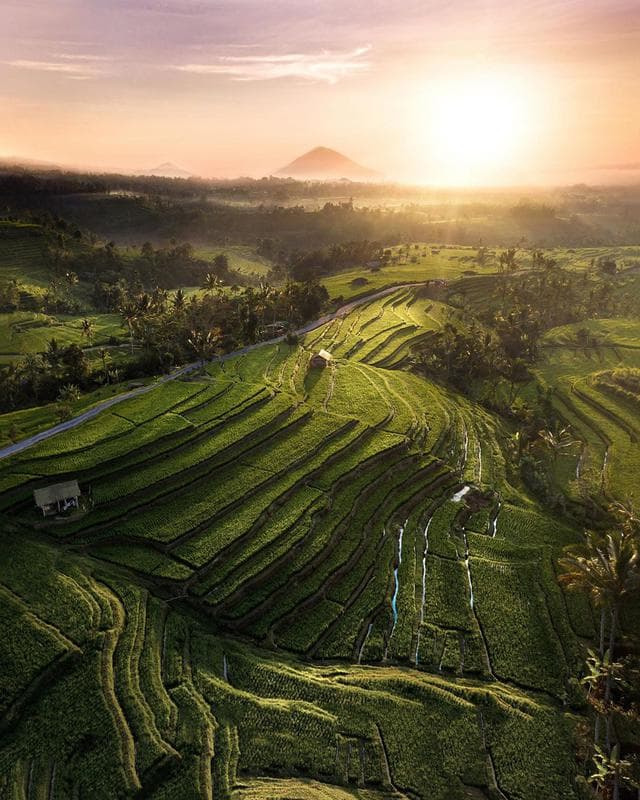
Working red-rice terraces under Mount Batukaru, with waymarked trails and one ticket.
By The Bali Guideline Editorial TeamUpdated 16 October 2026
Overview
Jatiluwih Rice Terraces, before you go.
Jatiluwih is a farming village in Tabanan whose rice terraces, at about 700 m on the slopes of Mount Batukaru, are the best-known part of Bali’s UNESCO subak listing. It is 1.5 to 2 hours by car from Ubud or Canggu, and foreigners pay IDR 75,000. Go if you will walk the trails through the working fields; for a quick photo stop, Tegallalang is closer.
Jatiluwih is a village of about 3,000 people on the southern slopes of Mount Batukaru, Bali’s second-highest volcano, and its terraces are the best-known part of the island’s only World Heritage Site. In 2012 UNESCO inscribed the Cultural Landscape of Bali Province: the Subak System as a Manifestation of the Tri Hita Karana Philosophy, five sites covering about 19,500 hectares. The largest, the Catur Angga Batukaru subak landscape at more than 17,300 hectares, takes in Jatiluwih, and UNESCO notes that its terraces are mentioned in a 10th-century inscription.
The subak is what you are looking at. Each subak is a cooperative of farmers who share water from one source, moving it through canals and weirs and marking each stage of the crop with offerings at shrines and water temples. UNESCO dates the system to the 9th century and ties it to Tri Hita Karana, the Balinese idea of balance between people, nature and the divine. Jatiluwih has seven rice-field subak and one for dry gardens, and many farmers still grow local red rice, a variety that takes four to six months to ripen.
On the ground, a road runs through the village past a ticket checkpoint and a string of restaurants, with the main viewpoint and the trailheads near the middle. Most tour groups stop for lunch and a photo, then leave, so the trails empty out a few minutes’ walk from the road. This is farmland, not a park: the dykes are the farmers’ paths, the shrines are in use and the crop decides what you see.
Recent years have been bumpy. The foreign ticket rose from IDR 40,000 to IDR 50,000 in April 2024 and was IDR 75,000 by April 2025. In November 2024 UN Tourism named Jatiluwih one of its Best Tourism Villages. Then on 2 December 2025 a Bali provincial council committee on spatial planning found 13 buildings in the protected rice land, mostly farmers’ huts turned into warungs, that it said broke farmland rules, and several were sealed. Farmers, who have long said little of the ticket money reaches them, answered with zinc sheets and black plastic across the view, and visits fell by up to 80 percent. The sheets came down on 5 January 2026, after the regency promised a moratorium on new building, and the Jatiluwih Festival returned on 20–21 June 2026.
Jatiluwih vs Tegallalang: Tegallalang, 10 km north of Ubud, is one steep valley owned by a handful of families, lined with cafés and swings, with several donation booths and no UNESCO status. Jatiluwih is far larger, sold under one ticket and farmed by its subak, with waymarked trails instead of swings. The price is the drive, and the cloud that often hides Batukaru after late morning.
- Opening hours
- Daily, ticket posts staffed about 8 am–6 pm (checked Oct 2026)
- Ticket
- IDR 75,000 foreign adults, IDR 50,000 children (checked Oct 2026)
- Time needed
- 2 hours for a short loop; half a day for a long trail
- Best time
- 7–10 am; April–October for drier trails
- Dress code
- No dress code; shoes with grip, a hat and a rain layer
- Location
- Penebel, Tabanan, about 45 km north-west of Ubud (1.5–2 hours)
Jatiluwih, Penebel, Tabanan Regency, Bali 82152, Indonesia
Open in Google MapsWhat to See
What to see at Jatiluwih Rice Terraces.
- 01
The main viewpoint and terrace road
The road through the village crosses the middle of the terraces, and the stretch around the main viewpoint and the UNESCO monument gives the classic view: tier after tier of paddies spread across the valley, with Mount Batukaru rising to the north-west. Restaurants such as Jatiluwih Resto, J-Terrace and Warung Wayan line this stretch with tables over the fields. Come before 10 am, when the mountain is usually clear and the tour vans are still on the road.
- 02
The waymarked trails
Colour-coded loops start near the ticket checkpoint and the main viewpoint, and walking them is included in the ticket. Guides disagree on colours and lengths because the set has changed over the years. The most repeated version runs from a red loop of about 1.5 km (30–45 minutes) through purple, yellow and blue loops of 2 to 3 km to a white route of about 5.5 km (3–4 hours); others describe green and blue loops of 6–7 km. Photograph the map board before you start.
- 03
A guided trek with a farmer
A local guide turns the walk into a lesson: which channel feeds which plot, why planters work backward while bowing toward the mountain, what the small shrines in the fields are for. The official site lists guided trekking from IDR 450,000 (checked Oct 2026), and village guides also lead longer walks to Wongaya Gede, about 10 km away near Pura Luhur Batukaru. Agree the route, length and price before you set off.
- 04
Planting or harvesting with farmers
The management sells farm sessions alongside trekking and cycling. You wade into a flooded paddy to set out seedlings by hand, or help cut the rice at harvest, while a farmer explains how the water is shared between plots. What is on offer depends on the crop that month; the red-rice harvest falls around June, and the 2026 festival let visitors join it. Book at least two days ahead and dress for knee-deep mud.
- 05
E-bikes on the back lanes
An electric bike takes you beyond the walking loops along farm tracks, irrigation channels and the villages behind the terraces, with the motor doing the climbs. Several warungs in the village rent bikes, including the Green Bike EV stand on the official map, and guided rides of one to two hours start in the village. The official site lists cycling packages from IDR 470,000 (checked Oct 2026). Motorbikes and cars are banned from the trekking paths.
- 06
Red rice on the table
Jatiluwih’s fields grow local red rice, and the restaurants along the terrace road serve it as nasi merah with Balinese dishes and sambal. Look for laklak, small pancakes of red-rice flour topped with grated coconut and palm sugar, and red-rice tea, the snacks the village chose for World Water Forum delegates in 2024. Order the red rice rather than white; it is the crop you came to see.
- 07
Sunrise and a night in the village
Most visitors see Jatiluwih at midday. A night here gives you first light instead, when mist sits in the valley, farmers walk out to the fields and the trails are empty. The village counts about 70 homestay rooms run by local families, plus a few villas and glamping sites. Evenings are cool and very quiet, and restaurants close early, so plan dinner before dark.
- 08
Temples among the fields
Small temples stand in and above the terraces, among them Pura Dalem Gunung Sari and Pura Luhur Bhujangga Waisnawa, along with the subak shrines where farmers leave offerings at each stage of the crop. The management’s rules say visitors may not enter a temple or sacred area without a guide, so admire them from the path unless someone local takes you in, and wear a sarong and sash if you do.
Seasons
Best time to visit Jatiluwih Rice Terraces.
Arrive between 7 and 10 am. Mount Batukaru is usually clear early, the light is low across the tiers, and the day tours from the south have not arrived. The main viewpoint is busiest from about 10 am to 2 pm, cloud often builds over the mountain by late morning, and afternoon showers are common even in the dry season. Late afternoon, after the tours head off to Tanah Lot, is quieter again, and only an overnight stay puts you on the trails at sunrise.
The crop matters more than the month, and blocks are planted at different times, so some part of the valley is usually green. The main season is local red rice: fields are ploughed and flooded around January and February, the paddies are deep green from about February to April, turn gold in May and are cut around June, when the 2026 festival was held. A second, shorter crop, often modern white rice, follows from about July, with green fields again from roughly August to October.
The dry season, April to October, gives firmer trails and clearer views; July and August are the driest and busiest months. From November to March afternoon storms are normal and the dykes get slippery. In March 2024 a landslide after a night of heavy rain buried a wooden villa in the subak area and killed two foreign guests, so take local warnings seriously in the wet season. Lebaran brings domestic crowds: on 30 March 2025 more than 2,500 people came in one day. Nyepi, on 8 March 2027, closes the whole island.
Getting There
How to get to Jatiluwih Rice Terraces.
| From | Time | How |
|---|---|---|
| Ubud | 1.5–2 hours | About 45 km north-west by car with a driver, across Badung and up through Penebel. Pura Taman Ayun in Mengwi breaks the drive. |
| Canggu | 1.5–2 hours | About 50 km north by car with a driver through Tabanan regency. Leave by 6:30 am to reach the terraces before the cloud and the tour vans. |
| Seminyak | 1.75–2.5 hours | About 50–58 km by car. Morning traffic through Kerobokan and Canggu sets the time. |
| Bali airport (DPS) | 1.75–2.5 hours | About 55–65 km by pre-booked car. Better as a day trip from your base than straight off a flight; late-afternoon traffic around Canggu is the worst. |
| Bedugul (Lake Beratan) | 45–60 min | About 25 km south-west by car via Baturiti, so the lake temple and the terraces fit into one cool day. |
| Sanur | 1.75–2.25 hours | About 50–60 km by car via the Denpasar ring roads. Avoid coming back in the 4–7 pm rush. |
| Uluwatu | 2.5–3 hours | About 75–80 km past the airport. Only worth it as a full day with a driver, or with a night in Tabanan. |
Getting around Jatiluwih Rice Terraces
Every visitor buys a ticket at the checkpoint on the road into the village, homestay guests included. Carry cash: online booking on the official site has been unreliable, and several of its booking pages returned errors when checked in October 2026. Parking is spread over public lots and restaurant car parks; at Lebaran 2025 the management counted 12 lots holding about 170 cars. On holiday weekends drivers often drop you near the viewpoint and park farther along the road.
Come with a car and driver. Grab and Gojek rarely send a car this far into the hills, and drivers seldom accept the trip back, so agree a round-trip price before you leave. The climb has steep, narrow bends and farm trucks; ride a scooter only if you are experienced, licensed and wearing a helmet. Most drivers combine Jatiluwih with Taman Ayun, Ulun Danu Beratan or a Tanah Lot sunset.
Once you are there, you walk. The trails mix concrete farm tracks, packed earth and grass dykes barely a shoe wide, with real descents and climbs on the longer loops and almost no shade. The dykes turn slick after rain and have no railings. If you cannot manage uneven ground, the road, the viewpoint and the restaurant terraces still show you most of the valley.
Know Before You Go
Jatiluwih Rice Terraces tips that save time and trouble.
- 01Bring cash in small notes for the ticket, parking, lunch and any guide, and do not count on cards at the checkpoint.
- 02Keep your ticket for the inner checkpoints; in 2024 the management said it includes visitor insurance.
- 03Stay on the marked paths, do not pick rice or fruit, and step off the dyke for farmers carrying loads.
- 04Wear shoes with grip, a hat and sunscreen, and carry water; the long loops have little shade and few places to buy a drink.
- 05Photograph the trail map at the start, since colours and lengths on the ground differ from many online guides.
- 06Pack a rain jacket in any month; cloud and showers often arrive by early afternoon.
- 07Flying a drone needs prior permission and costs IDR 300,000 extra (checked Oct 2026).
- 08Do not enter temples or field shrines without a local guide, and never use them as photo props.
- 09Book planting, guided treks or cycling at least two days ahead through the DTW Jatiluwih office, whose numbers are on jatiluwih.id.
- 10Pair the terraces with Pura Luhur Batukaru, 25–35 minutes away, or Ulun Danu Beratan, 45–60 minutes away.
FAQ
Jatiluwih Rice Terraces questions, answered.
How much is the Jatiluwih entrance fee?
IDR 75,000 for foreign adults and IDR 50,000 for foreign children, with IDR 25,000 and IDR 15,000 for Indonesians, according to the official Jatiluwih site (checked Oct 2026). Foreigners paid IDR 40,000 until March 2024 and IDR 50,000 from April 2024. Some 2026 travel guides report IDR 100,000 at the gate, so carry extra cash. The trails are included; a drone costs IDR 300,000 extra.
Is Jatiluwih worth visiting?
Yes, if you will walk. The terraces are the largest and best-known part of Bali’s UNESCO subak listing, and a few minutes down any trail you leave the crowd behind. It is less rewarding as a 20-minute photo stop at the end of a two-hour drive, or on a cloudy wet-season afternoon. Go early, walk at least one loop and order red rice for lunch.
Jatiluwih or Tegallalang: which is better?
Jatiluwih, if you have a full day. It is part of the UNESCO listing, far wider and calmer, with one ticket and waymarked trails. Tegallalang, 10 km north of Ubud, is a narrow valley of cafés, swings and donation booths that fits into a morning with Tirta Empul. The two are about 56 km apart by road, around two hours’ drive, so few people see both on one day.
What is the best time to visit Jatiluwih?
Between 7 and 10 am, in any month. Mornings give clear views of Mount Batukaru before the cloud builds, and you beat the day tours. April to October is drier and easier for the long trails; July and August are the busiest. For green fields, February to April is the most reliable window, and the red-rice harvest comes around June.
When are the Jatiluwih rice fields green, and when is the harvest?
The main red-rice crop is planted around January and February, stays green until about April, turns gold in May and is cut around June. A second, shorter crop follows from about July, so fields are green again from roughly August to October. Blocks are planted at different times, so some green is usually visible. Check recent photos a few days before you go.
How do I get to Jatiluwih?
By car with a driver. It is about 45 km and 1.5 to 2 hours from Ubud, about 50 km and 1.5 to 2 hours from Canggu, 1.75 to 2.5 hours from Seminyak or the airport, and 45 to 60 minutes from Bedugul. There is no useful public transport, and Grab or Gojek drivers rarely accept the return trip from the hills, so book a round trip.
Which Jatiluwih trekking route should I walk?
With an hour or two, take the short red loop, about 1.5 km and 30 to 45 minutes, or a mid-length loop of 2 to 3 km. With a full morning and dry weather, take a long route of 5.5 to 7 km, which drops into the valley and takes three to four hours. Colours change, so check the board at the start. The trails are free with your ticket; a guide costs extra.
Is Jatiluwih a UNESCO World Heritage Site?
Yes, as part of a larger listing. In 2012 UNESCO inscribed the Cultural Landscape of Bali Province, five sites linked by the subak irrigation system. Jatiluwih sits in the largest, the Catur Angga Batukaru landscape, which also includes Pura Luhur Batukaru. The others are Lake Batur, Pura Ulun Danu Batur, the Pakerisan valley near Tampaksiring and Pura Taman Ayun.
How long do you need at Jatiluwih?
Two hours covers the viewpoint and a short loop. Half a day lets you walk a long trail and eat lunch above the fields. Add 1.5 to 2 hours’ drive each way from Ubud or Canggu, which is why most people pair Jatiluwih with Pura Luhur Batukaru, Ulun Danu Beratan or a Tanah Lot sunset.
Is Jatiluwih open after the 2025 dispute?
Yes. In December 2025 farmers put zinc sheets and plastic across the view after a provincial council inspection sealed buildings in the protected rice land, and visits fell by up to 80 percent. The sheets came down on 5 January 2026, when the regency promised a building moratorium, and the Jatiluwih Festival ran on 20–21 June 2026. The official site was selling tickets in October 2026, and visitors were back through mid-2026.
Can you stay overnight in Jatiluwih?
Yes. The village has about 70 homestay rooms plus a few villas and glamping sites, and a night there gives you the terraces at sunrise without the drive. Evenings are cool and quiet, with early dinners and nothing open late. Guests still pay the entrance fee. In the wet season, choose a place on stable ground rather than at the foot of a steep bank.
What should I wear to Jatiluwih?
There is no dress code for the terraces. Wear shoes or sandals with grip, light clothes, a hat and a rain layer; at about 700 m, days run about 22 to 27°C and early mornings feel cool. Cover your shoulders and knees and bring a sarong and sash if you plan to visit a temple, including Pura Luhur Batukaru.
Nearby
Where to go after Jatiluwih Rice Terraces.
Places close by that fit into the same trip, with honest travel times.
25–35 min by car (about 10 km)
Pura Luhur Batukaru
One of Bali’s six holiest temples, the guardian of the west, rebuilt in 1959 in damp forest at the foot of the mountain; a donation covers the sarong.
45–60 min by car (about 25 km)
Ulun Danu Beratan
The 17th-century lake temple at Bedugul, higher and cooler; go on there after the terraces, which are best while Batukaru is clear in the morning.
Visitor guide30–40 min by car (about 14 km)
Yeh Panas hot springs, Penatahan
Warm spring pools beside a riverside temple, the best place in Tabanan to rest your legs after a long trail.
1–1.25 hours by car (about 38 km)
Pura Taman Ayun
The moated royal temple of Mengwi, part of the same UNESCO listing, and the natural break on the drive from Ubud or Canggu.
Visitor guide1.25–1.75 hours by car (about 36 km)
Tanah Lot
The sea temple on its rock, the classic end to a Tabanan day; check the tide table before you plan around it.
Visitor guideAbout 1 hour by car (29 km)
Subak Museum, Sanggulan
Farm tools and an open-air model subak explain what you see in the fields; it sits on the main road from the south.
More in Tabanan
Plan the rest of your time in Tabanan.
Read Next
More Jatiluwih Rice Terraces guides.

How we researched this
Sources and fact checks.
Prices, opening hours, show times and travel times in this Jatiluwih Rice Terraces guide were checked against official sites, government tourism pages and recent reporting on 16 October 2026. Where sources disagreed, we give the official figure and say so. Rankings are our editorial judgment, set out in our editorial policy.
We re-check the guide at least every three months and whenever we hear about a change. Spotted something out of date? Tell us.
Show all 33 sources ↓Hide sources ↑
- jatiluwih.id/%20(official:%20ticket%20prices,%20drone%20fee,…
- jatiluwih.id/product/entrance-fee/%20(official%20notice:%20I…
- jatiluwih.id/point-of-interest/%20(official%20map:%20checkpo…
- jatiluwih.id/mantan-presiden-hungaria-simak-proses-tanam-hin…
- whc.unesco.org/en/list/1194
- whc.unesco.org/en/decisions/4797%20(36th%20session,%202012;%20…
- indonesia.travel/gb-en/tourism-village/desa-wisata-jatiluwih%20(…
- bali.antaranews.com/berita/374489/dtw-jatiluwih-sediakan-12-kantong…
- mongabay.co.id/2024/03/16/longsor-di-kawasan-warisan-budaya-du…
- detik.com/bali/berita/d-8244362/sidak-pansus-trap-berbuah…
- detik.com/bali/berita/d-8248924/redam-kisruh-jatiluwih-bu…
- detik.com/bali/berita/d-8293424/dprd-bali-rekomendasikan-…
- rri.co.id/denpasar/wisata/2115467/jatiluwih-bangkit-pasca…
- bali.antaranews.com/berita/406433/bangun-citra-pariwisata-jatiluwih…
- bali.antaranews.com/berita/407384/dtw-jatiluwih-tingkatkan-kunjunga…
- bali.antaranews.com/berita/410413/jatiluwih-garap-aktivitas-wisata-…
- rri.co.id/denpasar/olimpik/2448793/masuk-ken-kemenpar-jat…
- rri.co.id/wisata/2560651/libur-sekolah-bawa-berkah-bagi-d…
- detik.com/bali/wisata/d-7641599/jatiluwih-bali-jadi-desa-…
- mongabay.co.id/2019/04/27/nasib-jatiluwih-setelah-menjadi-wari…
- mongabay.co.id/2019/04/29/nasib-jatiluwih-setelah-menjadi-wari…
- mongabay.co.id/2020/02/08/menikmati-kemegahan-sawah-dan-reflek…
- goodnewsfromindonesia.id/2019/05/11/asyiknya-trekking-di-world-heritage-…
- jatiluwih.com/destinations/jatiluwih-walking-trails
- jatiluwih.com/best-time-to-visit-jatiluwih
- sunshineseeker.com/destinations/jatiluwih-rice-terraces-bali/%20(t…
- baliholidaysecrets.com/jatiluwih-bali-travel-guide/%20(reports%20IDR%2…
- en.wikipedia.org/wiki/Pura_Luhur_Batukaru
- bali.com/places/luhur-batukaru-temple
- id.wikipedia.org/wiki/Jatiluwih,_Penebel,_Tabanan%20(population,…
- openstreetmap.org
- https://router.project-osrm.org (road distances to Ubud, Canggu, Seminyak, the airport, Sanur, Uluwatu, Bedugul, Batukaru, Penatahan, Taman Ayun, Tanah Lot, Tegallalang)
- thebaliguideline.com/blog/must-things-to-do-in-bali%20(hero%20photo%…