
Nusa Penida · Nature
Peguyangan Waterfall, Nusa Penida: The Blue Stairs Guide
A blue stairway down Nusa Penida’s south cliff to a sacred spring and a sea temple.
By The Bali Guideline Editorial TeamUpdated 11 November 2026
Overview
Peguyangan Waterfall, before you go.
Peguyangan is a spring at the foot of Nusa Penida’s south cliffs in Batukandik village, about 21 km (45 to 60 minutes) from Toyapakeh harbor. You reach it by a blue stairway of about 700 steps that ends at Pura Segara Kidul, a sea temple. It is worth it for fit visitors with a full day on the island who want the coast without the Kelingking crowds. The “waterfall” itself is small.
Peguyangan is not really a waterfall. It is a freshwater spring at the foot of the south cliffs of Nusa Penida, in Batukandik village, and you reach it by a blue-painted stairway fixed to the rock face. Most guides count about 700 steps, but a Balinese culture site puts the figure as high as 870. The name is usually traced to guyang, to bathe. The “waterfall” in the photos is spring water spilling from a tank and pipes into the sea, so come for the stairway, the coastline and the temple at the bottom rather than a cascade.
The spring matters far more to the island than to tourists. Nusa Penida is dry limestone, and Guyangan, as the spring is officially called, is one of its largest water sources: a study cited in Balinese reporting puts its flow at about 178 liters per second. The regency water company, PDAM Klungkung, sends its water to villages on the plateau, including Batukandik, Klumpu and Bunga Mekar, which is why thick pipes run beside the stairs all the way down. Treat them as working infrastructure, not handrails.
At the bottom stands Pura Segara Kidul, the temple of the southern sea. Balinese come here for melukat, a purification rite under the spring spouts at the entrance, and the temple sometimes hosts mass melukat ceremonies for devotees from other villages. Visitors may enter in a sarong and sash, rented at the top. By custom, women who are menstruating do not go in.
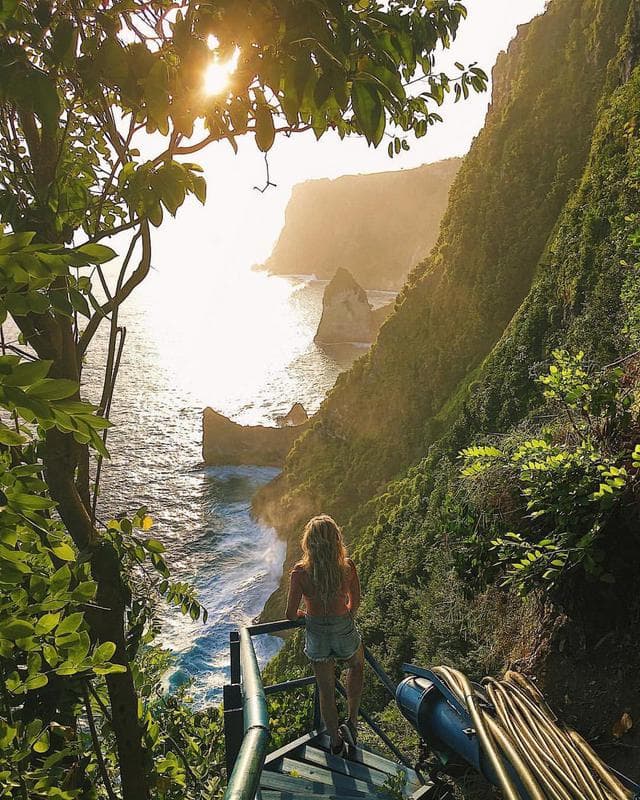
The descent is the experience. Some sections pitch at 70 to 80 degrees, the treads are narrow, and the sea booms against the rocks below. Going down takes 20 to 30 minutes. The climb back takes longer, much of it in full sun. One guide updated in January 2026 warns that parts of the stairway have not been maintained in years. There is no lighting, no lifeguard and no rescue post, and serious injuries mean a boat to mainland Bali.
The rock pools past the temple, once the main draw, are now a question mark. Two travel guides report that a landslide damaged the ledge and that the pools can no longer be reached, one dating it to heavy rain on 9 January 2025 and the other to early 2026. No official notice has been published, so ask at the parking lot before you go down, and stay out of any pool that waves wash over.
Costs are low. Peguyangan was not among the six sites that began charging Klungkung’s IDR 25,000 site ticket in September 2026, and there is no official entrance fee, only parking and sarong rental. The catch is distance: it is a long drive from the harbors on a narrow road, so it suits visitors spending at least one night on Nusa Penida, ideally paired with Tembeling and the southern uplands.
- Opening hours
- No set hours; daylight only, as the stairs are unlit (checked Nov 2026)
- Ticket
- No entry fee; parking IDR 2,000–5,000, sarong rental extra (checked Nov 2026)
- Time needed
- 1.5–2 hours, including the climb back up
- Best time
- Before 10 AM in the dry season, April–October
- Dress code
- Sarong and sash for the temple, rented at the top; shoes with grip
- Location
- Batukandik, south coast; about 21 km (45–60 min) from Toyapakeh
Peguyangan, Batukandik, Nusa Penida, Klungkung Regency, Bali 80771, Indonesia
Open in Google MapsWhat to See
What to see at Peguyangan Waterfall.
- 01
The blue stairway
The stairs start beside a small parking area and warung on the cliff top and zigzag down the face, painted bright blue and fenced with metal rails. Counts vary from just under 700 to about 870 steps, and some sections are close to a ladder. Take it slowly, keep one hand on the rail, and let people coming up have the inside line. Allow 20 to 30 minutes down and more to climb back.
- 02
The view along the south coast
Halfway down, the cliffs open up east and west, with rock stacks standing off the shore and white water working at their base. This is the photo most people come for, and it is best in the softer light of early morning or late afternoon. Visitors sometimes spot manta rays from the stairs in the sea below. Manta Point, the cleaning station that snorkel boats visit, lies off this coast.
- 03
Pura Segara Kidul
The stairway ends at Pura Segara Kidul, a small sea temple facing the Indian Ocean. Water from the spring runs through spouts at the entrance, where Balinese bathe for melukat, a purification rite, and visitors may join if they follow the steps and the custom. Wear a sarong and sash, walk behind anyone praying, and do not climb on the shrines. On ceremony days the temple is busy with families and offerings.
- 04
The spring and the “waterfall”
The water is the reason the stairway exists. Pipes carry it from the spring up the cliff to the villages of the plateau, and the overflow from a tank pours down the rock into the sea. In the wet season the flow is fuller, and in the dry months it can be a modest trickle. Photograph it from the stairs, and keep off the pipes, pumps and tank.
- 05
The rock pools: check first
Beyond the temple, a ledge of rock pools a few meters above the sea once made Peguyangan famous as an “infinity pool.” Two travel guides say a landslide damaged the ledge, dated to 9 January 2025 in one and early 2026 in the other, and that the pools are no longer reachable. With no official notice, ask locals at the top. Even when the pools are open, the rocks are slick and the swell can surge in.
- 06
A south-coast loop
Peguyangan sits in the least visited part of the island, so make a day of the area. Tembeling’s forest pools and Pura Puncak Mundi, on the island’s highest ground at about 520 m, are each roughly 11 to 12 km away by road, and Teletubbies Hill is a similar distance east. With an early start, a driver can link three of these and still have you at the harbor for the afternoon.
Seasons
Best time to visit Peguyangan Waterfall.
Start down before 10 AM, ahead of the heat and most visitors. Much of the stairway is in full sun by late morning, and the climb back up is far easier in the cool of the day. A Balinese guide to the site recommends the hour after sunrise and the hour before sunset for the light and the calmer sea. If you come late, leave enough daylight for the climb, as the stairs are not lit.
April to October, the dry season, gives the safest footing and calmer seas. From November to March, heavy rain makes the treads slippery, and one of the two landslide reports blames heavy rain in January. If it is pouring or the sea is rough, skip the descent, or at least the pools. When the pools were open, the advice was to use them only at low tide in a calm sea.
Pura Segara Kidul holds ceremonies through the year, when the stairs fill with villagers carrying offerings. Give them the right of way. Nyepi, the day of silence, falls on 8 March 2027, and the whole island stays home that day, so plan around it.
Coming between November and March? Read our Bali rainy season guide →
Getting There
How to get to Peguyangan Waterfall.
| From | Time | How |
|---|---|---|
| Toyapakeh or Banjar Nyuh harbor | 45–60 min | About 21–23 km south by car or scooter, up through the interior to Batukandik, then down narrow lanes to the parking area. Most Sanur fast boats land at Banjar Nyuh, next to Toyapakeh. |
| Sampalan or Buyuk harbor | 40–60 min | About 17 km by road across the plateau. Sampalan is where boats from Kusamba land. Buyuk sits between Sampalan and Toyapakeh. |
| Sanur Harbour | 2–2.5 hours | Fast boat to Banjar Nyuh, Buyuk or Sampalan in 30–45 min, about IDR 170,000–250,000 one way in October 2026, then 40–60 min by road. Check in 60–90 min before departure. |
| Bali airport (DPS) | 3–4 hours | 30–60 min by car to Sanur Harbour, check-in and the crossing, then the drive south. If you land after mid-afternoon, sleep in Sanur and cross in the morning. |
| Nusa Lembongan | 1–1.5 hours | Local boat to Toyapakeh in 10–15 min, about IDR 60,000 each way in October 2026, then 45–60 min by road. |
| Kelingking Beach or Crystal Bay | 35–50 min | About 16 km from Kelingking and 22 km from Crystal Bay by road, through Bunga Mekar or Sakti and across the uplands. |
Getting around Peguyangan Waterfall
There is no Grab or Gojek on Nusa Penida. Most visitors come with a driver hired for the day, about IDR 700,000 to 1,000,000 for a car in October 2026, or on a rented scooter. The final kilometers are narrow, steep and patched in places, and recent guides describe a bumpy last stretch, so novice riders should take a driver. Local ojek riders in Batukandik can also run you to the top.
Parking at the top costs about IDR 5,000 for a car and IDR 2,000 for a scooter, according to a February 2026 report, and a warung sells drinks and snacks. Toilets are basic, and phone signal can drop out on the cliff. Rent a sarong and sash here, for about IDR 10,000 to 15,000, before you start down.
From the parking area it is stairs only, with no other way down or up. Leave large bags in the car, carry at least a liter of water per person, and wear shoes with grip, since flip-flops slide on wet treads. If you are carrying a drone or a camera, use a strap: anything dropped here goes into the sea.
Know Before You Go
Peguyangan Waterfall tips that save time and trouble.
- 01Ask at the parking lot whether the rock pools past the temple are open before you head down.
- 02Wear shoes with grip and keep one hand on the rail. Some sections are close to vertical.
- 03Carry at least a liter of water per person and some cash, since the only warung is at the top.
- 04Rent a sarong and sash at the top, as you need both to enter Pura Segara Kidul.
- 05Do not hold on to or stand on the water pipes. They supply the villages above.
- 06Skip it if you have knee problems, a fear of heights or small children who cannot manage steep stairs.
- 07Leave the cliff before dusk. There is no lighting on the stairway and no rescue post.
- 08Check that your insurance covers you here: a serious injury means a boat to mainland Bali.
FAQ
Peguyangan Waterfall questions, answered.
Is Peguyangan Waterfall worth it?
Yes, if you are fit, have a full day on Nusa Penida and want dramatic coast without the crowds of Kelingking. The stairway, the view and the sea temple are the reward. It is not worth it on a rushed day trip, if you expect a real waterfall, or if the rock pools are your only reason to go, since recent guides report they can no longer be reached.
How many steps are there at Peguyangan?
About 700. Counts vary between sources, from just under 700 to about 870, depending on where you start counting. Some sections pitch at 70 to 80 degrees. Most people take 20 to 30 minutes to go down and longer to climb back up, so allow 1.5 to 2 hours for the whole visit.
Is there really a waterfall at Peguyangan?
Not in the usual sense. Peguyangan is a spring at the foot of the cliff, piped up to villages on the plateau. The “waterfall” is overflow from a tank and the pipes, spilling down the rock into the sea. It looks fuller in the wet season. Come for the stairs, the coastline and Pura Segara Kidul.
Are the Peguyangan pools open?
Probably not. Two travel guides report that a landslide damaged the rock ledge and that the pools can no longer be reached, one dating it to 9 January 2025 and the other to early 2026. No official notice has been published, so ask locals at the parking lot before you go down. Even when the pools are open, the rocks are slippery and waves can wash in.
How much does it cost to visit Peguyangan?
There is no official entrance fee (checked Nov 2026). Expect to pay for parking, about IDR 5,000 for a car and IDR 2,000 for a scooter, and for a sarong and sash, about IDR 10,000 to 15,000. Peguyangan was not among the sites ticketed under Klungkung’s new system in September 2026, but foreign visitors still pay the island fee on arrival.
Is Peguyangan dangerous?
It is steep and exposed rather than dangerous if you take care. The stairs are narrow and close to vertical in places, one recent guide says parts have not been maintained in years, and there is no lighting, lifeguard or rescue post. The rock pools sit just above the sea and are reported closed after a landslide. Go in dry weather, in daylight, with good shoes.
How long does it take to get to Peguyangan?
About 45 to 60 minutes by road from Toyapakeh or Banjar Nyuh harbor, roughly 21 km, and 40 to 60 minutes from Sampalan. From Kelingking or Crystal Bay allow 35 to 50 minutes. From Bali, add a 30- to 45-minute fast boat from Sanur and check-in, so plan on two hours or more each way.
Do I need a sarong at Peguyangan?
Yes, to enter Pura Segara Kidul at the bottom of the stairs. You need a sarong and a sash, which you can rent at the top for about IDR 10,000 to 15,000 or bring your own. By local custom, women who are menstruating do not enter the temple. You can still walk the stairs in ordinary clothes.
Can you do Peguyangan on a day trip from Bali?
Only just. With the boat, check-in and about an hour each way by road, Peguyangan uses most of a day on its own, and the last fast boats to Sanur leave around 5 PM. Combine it with Tembeling or Pura Puncak Mundi rather than the west-coast sights, or stay a night on the island.
What is Pura Segara Kidul?
A small Balinese sea temple at the bottom of the Peguyangan stairs. The name means temple of the southern sea. Balinese come to bathe under its spring spouts for melukat, a purification rite, and it sometimes hosts mass melukat ceremonies. Visitors may enter in a sarong and sash. Keep quiet, walk behind people praying and give way during ceremonies.
Nearby
Where to go after Peguyangan Waterfall.
Places close by that fit into the same trip, with realistic travel times.
About 12 km, 25–35 min by road, plus a walk down
Tembeling forest and pools
Spring-fed pools and a small temple at the end of a forest track; one natural pool is open for a swim.
About 11 km, 25–35 min by road
Pura Puncak Mundi
A temple on the island’s highest ground at about 520 m, cooler and quiet outside ceremony days.
About 12 km, 25–35 min by road
Teletubbies Hill
Rows of small rounded hills in the Tanglad area, bright green from about December to April.
About 16 km, 35–45 min by road
Kelingking Beach
The T-Rex headland viewpoint, best before 10 AM or after 3 PM.
Visitor guideAbout 24 km, 40–50 min by road
Goa Giri Putri
A cave temple entered through a narrow gap in the rock, on the way to the east coast.
Visitor guideAbout 21 km, 45–60 min by road
Diamond Beach
The east coast’s cliff staircase and white sand, best on a separate morning.
Visitor guide
More in Nusa Penida
Plan the rest of your time in Nusa Penida.
Area guide
Nusa Penida travel guide
Read the guide
Viewpoint
Kelingking Beach
Visitor guide
Nature
Broken Beach and Angel’s Billabong
Visitor guide
Beach
Diamond Beach
Visitor guide
Beach
Crystal Bay
Visitor guide
Temple
Goa Giri Putri Cave Temple
Visitor guide
Nature
Manta Point and Manta Bay
Visitor guide
Beach
Atuh Beach
Visitor guide
How we researched this
Sources and fact checks.
Prices, opening hours, show times and travel times in this Peguyangan Waterfall guide were checked against official sites, government tourism pages and recent reporting on 11 November 2026. Where sources disagreed, we give the official figure and say so. Rankings are our editorial judgment, set out in our editorial policy.
We re-check the guide at least every three months and whenever we hear about a change. Spotted something out of date? Tell us.
Show all 16 sources ↓Hide sources ↑
- balipost.com/news/2026/09/11/580985/Retribusi-Pariwisata-Klu…
- balipost.com/news/2026/08/18/575011/Berlaku-Per-1-September,…
- detik.com/bali/berita/d-8614076/pungutan-retribusi-rp-25-…
- budayabali.com/peguyangan-spring
- tatkala.co/2020/05/04/paradoks-geografi-nusa-penida-tandus…
- nusapenida.org/id/guyangan
- theworldtravelguy.com/peguyangan-waterfall-in-nusa-penida-bali
- shewandersabroad.com/peguyangan-waterfall-nusa-penida
- journeyera.com/peguyangan-waterfall-nusa-penida-bali
- nominatim.openstreetmap.org/ui/search.html
- router.project-osrm.org
- nusapenida.org/how-to-get-to-nusa-penida
- nusapenida.org/get-around-nusa-penida
- nusapenida.org/tembeling
- detik.com/bali/berita/d-7372562/jalanan-di-nusa-penida-se…
- thebaliguideline.com/blog/top-7-nusapenida