
Nusa Lembongan · Viewpoint
Yellow Bridge, Nusa Lembongan: Crossing to Nusa Ceningan
A 138 m suspension bridge over the seaweed channel, open to walkers and scooters only.
By The Bali Guideline Editorial TeamUpdated 11 November 2026
Overview
Yellow Bridge, before you go.
The Yellow Bridge is the narrow suspension bridge that links Nusa Lembongan to Nusa Ceningan, about 3.5 km from the Jungutbatu boat landing. It is free, open only to walkers, bicycles and scooters, and the only land route onto Ceningan. Cross it on the way to the Blue Lagoon, and walk it once for the view over the seaweed farms.
The Yellow Bridge, Jembatan Kuning in Indonesian, crosses the shallow channel between Nusa Lembongan and its smaller neighbor, Nusa Ceningan. According to Indonesia’s public works ministry it is a suspension bridge 138 m long and 1.8 m wide, in three spans of 24, 90 and 24 m. Locals also call it the love bridge, and couples stop on it for photos. It is the only fixed link between the islands, so everything that reaches Ceningan by land, from groceries to wedding guests, comes across this deck on foot or on two wheels.
The bridge has a hard history. The first crossing here went up in 1996. On the evening of 16 October 2016, at about 6:30 PM, it gave way while it was packed with villagers heading to a ceremony at Pura Bakung, the temple at the Ceningan end, for Nyepi Segara, the day of silence for the sea. Eight people died and 34 were injured, all of them locals. Indonesia’s disaster agency blamed overloading and a snapped cable on a structure that had been patched many times.
The national government rebuilt it fast. Work began on 10 November 2016, with a new steel deck on the old foundations. It was finished on 9 March 2017 at a cost of IDR 3.4 billion and inaugurated on 31 March 2017. The yellow paint was kept, and so was the rule that cars, trucks and golf buggies stay off.
The visit itself is simple. Walk or ride across in a few minutes, stop where there is room, and look down the channel, where seaweed plots are staked out in the shallows on both sides and farmers work them with the tide. Upkeep is constant in salt air: in July 2022 the regency closed the bridge to vehicles for 24 hours to replace a corroded section of deck. In October 2025 two tourists on a scooter hit the railing and fell into the water. Police said the railing was badly rusted and taped off the damaged section.
A second, wider bridge for cars has been planned for years. In September 2025 Klungkung regency said the IDR 112 billion project would be built in 2026, and in April 2026 it still appeared on the province’s list of projects due by 2029. No start of construction had been reported by November 2026, so for now the Yellow Bridge remains the only way across.
- Opening hours
- Open at all hours; no gate (checked Nov 2026)
- Ticket
- Free; not one of the regency’s ticketed sites (checked Nov 2026)
- Time needed
- 5 min to cross; 15–30 min to walk it and take photos
- Best time
- Early morning or late afternoon, when scooter traffic is lighter
- Dress code
- None for the bridge; sarong and sash to enter Pura Bakung
- Location
- South of Lembongan village, about 3.5 km from Jungutbatu
Today at Yellow Bridge
- Sunset
- Sunrise
- Daylight
- 12 hr 29 min
Checking the weather in Nusa Penida…
Times for this spot, in Bali time (WITA).
Yellow Bridge (Jembatan Kuning), Lembongan, Nusa Penida, Klungkung Regency, Bali, Indonesia
Open in Google MapsWhat to See
What to see at Yellow Bridge.
- 01
Walking the deck
The bridge is 138 m long, so the walk takes two or three minutes, and it is the best way to see it. The steel deck rattles and clanks as scooters pass. The main span over the channel is 90 m, and its middle gives the widest view. Keep to one side, stop only where riders can still get past, and hold children by the hand.
- 02
The seaweed farms in the channel
Before tourism, Lembongan and Ceningan lived on seaweed grown on lines staked out in the shallows, and the plots still fill the channel on both sides of the bridge. Many families went back to farming in 2020, when the pandemic emptied the islands of visitors. From the deck you see the grid of plots, the farmers wading between them and the harvest drying on the shore. Ask before you photograph anyone up close.
- 03
Pura Bakung at the Ceningan end
The temple right by the Ceningan end of the bridge is Pura Bakung. On the evening of 16 October 2016, villagers were crossing to a ceremony here for Nyepi Segara when the old bridge collapsed. It is an active temple, not a sight. Look from the lane, and if you want to go in, wear a sarong and sash and ask someone from the village first. On ceremony days, give processions the right of way on the bridge.
- 04
The ride onto Nusa Ceningan
Ceningan is a hilly island about 4 km long, and the bridge is where its lanes begin. From the far end, the road climbs about 2.3 km to the Blue Lagoon on the southwest coast, around 10 minutes by scooter. The lanes are narrow, steep and in places rough, with blind corners, so ride slowly, use your horn on bends and keep your speed down on the descents.
- 05
Photos from the approaches
The classic shot of the bridge is from the shore at either end, with the yellow towers and cables framed against the water. Take it from the lane or the shoreline rather than from the middle of the deck, where you block traffic. The channel is fullest at high tide on a sunny morning. At low tide, the seaweed plots and sandbanks show instead.
Seasons
Best time to visit Yellow Bridge.
Early morning and late afternoon are the calmest times on the bridge. From late morning to mid-afternoon, day-trippers from Bali ride between Lembongan and the Blue Lagoon, and the deck sees a steady stream of scooters. The light is softest after about 4 PM, and the sun sets between about 6:05 PM in May and June and 6:45 PM in late January and February. Ride the lanes on Ceningan in daylight if you can.
Tide changes what you see from the deck. Near high tide the channel fills with clear green water. Near low tide, sandbanks and seaweed plots appear and farmers wade out to work them. Check a tide table for Lembongan if you want one or the other. April to October is the dry season, with the clearest water. January and February are the wettest months.
Ceremonies matter here. Processions to Pura Bakung cross the bridge, and the 2016 collapse happened during the Nyepi Segara ceremony, when crowds packed the old deck. Nyepi Segara closes the sea around the Nusa islands for 24 hours each year around the full moon of September or October. In 2026 it began at 6 AM on 27 September. Nyepi, on 8 March 2027, keeps everyone indoors for a day.
Coming between November and March? Read our Bali rainy season guide →
Getting There
How to get to Yellow Bridge.
| From | Time | How |
|---|---|---|
| Jungutbatu boat landing | 10–15 min | About 3.5–4 km by scooter or truck taxi through Lembongan village. On foot it is about 50 minutes on hilly lanes. Most fast boats from Sanur land at Jungutbatu. |
| Lembongan village | 5–10 min | About 2 km by scooter, or 25–30 minutes on foot. Truck taxis stop at the Lembongan end of the bridge; from there you walk across. |
| Mushroom Bay | 10–15 min | About 3 km by scooter, or 40 minutes on foot. Some fast boats from Sanur land in the bay. |
| Devil’s Tear and Dream Beach | 10–15 min | About 3 km by scooter across the south of the island, or 40 minutes on foot. |
| Sanur Harbour | 1–1.5 hours | Fast boat to Jungutbatu or Mushroom Bay in 30–40 minutes, about IDR 150,000–300,000 one way (checked Oct 2026), then the ride. One fast-boat company docks at Telatak, near the Lembongan end of the bridge. |
| Bali airport (DPS) | 2.5–3.5 hours | 30–60 minutes by car to Sanur Harbour, check-in about an hour before departure, the crossing and the ride. If you land after about 2 PM, sleep in Sanur and cross in the morning. |
| Nusa Penida (Toyapakeh) | 30–45 min | Local boat to Lembongan in 10–15 minutes, about IDR 60,000 each way (checked Oct 2026), then 10–15 minutes by road. |
Getting around Yellow Bridge
Nusa Lembongan has virtually no cars, and Grab and Gojek do not operate. Most visitors ride a rented scooter, about IDR 80,000–150,000 a day, or a bicycle (checked Oct 2026). Open-backed truck taxis and rented golf buggies can reach the Lembongan end of the bridge but are not allowed across, so their passengers walk over and continue on foot or by scooter.
The deck is 1.8 m wide, and two scooters pass each other with little room. Ride across slowly in a straight line, do not stop mid-span for photos, and give way to walkers and anyone carrying loads. In October 2025 two riders who could not pass an oncoming scooter hit the railing and fell into the channel. If you are new to scooters, push the bike across on foot.
Walking works well. The bridge is about 2 km from Lembongan village and 3.5–4 km from Jungutbatu. Carry water, as the lanes are hot and hilly at midday. On the Ceningan side the roads climb steeply, so many walkers cross, look around and turn back, or arrange a scooter for the rest of the island.
Tickets & Tours
Yellow Bridge tours on Klook.
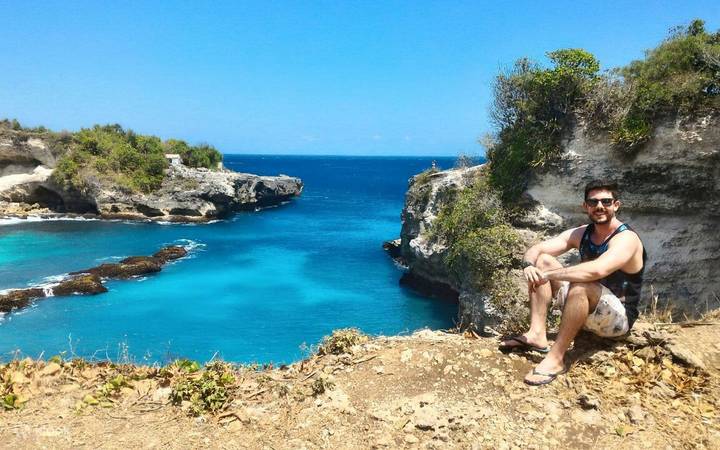
You can visit on your own with the details above. If you would rather have the driver, guide or entry sorted, these Klook tours include Yellow Bridge. Prices, pick-up areas and what is included vary, so check the listing before you book.
Affiliate links: we may earn a commission if you book, at no extra cost to you. Affiliate disclosure
Know Before You Go
Yellow Bridge tips that save time and trouble.
- 01Only walkers, bicycles and scooters may cross. Cars, trucks and golf buggies stop at the Lembongan end.
- 02Ride across slowly and do not overtake. The deck is 1.8 m wide, and riders have hit the railing trying to pass.
- 03Do not stop mid-span to pose while traffic is moving. Take photos from the approaches or step to the side between scooters.
- 04Wear a helmet. The lanes on both sides are narrow and steep, with sand and blind corners.
- 05Give way to processions and to locals carrying offerings or seaweed. This is a working village bridge first.
- 06Foreign visitors owe Klungkung’s area fee for Lembongan and Ceningan, IDR 25,000 per adult and IDR 15,000 per child aged 4–13, paid cashless (checked Oct 2026). The bridge itself is free.
- 07Carry small cash for drinks and parking on Ceningan, since card surcharges are common on the islands.
- 08Ask before photographing seaweed farmers close up, and keep off the lines and drying racks.
- 09Plan around the boats. The last departures to Sanur leave around 4:30–5 PM, so day-trippers should be back across by mid-afternoon.
FAQ
Yellow Bridge questions, answered.
Can you drive a car across the Yellow Bridge?
No. The bridge is only for walkers, bicycles and two-wheeled motor vehicles, according to Indonesia’s public works ministry. Truck taxis and golf buggies stop at the Lembongan end, and passengers walk across. A wider bridge for cars has been planned for years, but no construction had been reported by November 2026.
Is the Yellow Bridge safe?
For walking and careful riding, yes, but it needs constant repair. The old bridge collapsed under a crowd in 2016, killing eight people, and the rebuilt deck has had corroded sections replaced since. In October 2025 two tourists fell into the channel after hitting a rusted railing on a scooter. Cross slowly, do not overtake and never crowd the deck in large groups.
What happened to the Yellow Bridge in 2016?
It collapsed at about 6:30 PM on 16 October 2016, while villagers were crossing to a ceremony at Pura Bakung on Ceningan for Nyepi Segara. Eight people died and 34 were injured. Indonesia’s disaster agency blamed overloading and a broken cable. The national government rebuilt it on the old foundations, and it reopened on 31 March 2017.
Is there a fee to cross the Yellow Bridge?
No. The bridge is free and has no gate, and it is not one of the regency’s ticketed sites (checked Nov 2026). Foreign visitors to Lembongan and Ceningan do owe Klungkung’s area fee, IDR 25,000 per adult and IDR 15,000 per child, which covers both islands. Bali’s IDR 150,000 tourist levy is separate.
How long is the Yellow Bridge?
It is 138 m long and 1.8 m wide, in three spans of 24, 90 and 24 m, according to Indonesia’s public works ministry. Some older reports give 140 or 150 m. Walking across takes two or three minutes, and riding across well under a minute.
How do you get to the Yellow Bridge from Jungutbatu?
Ride or take a truck taxi about 3.5 to 4 km south through Lembongan village, 10 to 15 minutes. On foot, allow about 50 minutes on hilly lanes. There is no Grab or Gojek on the island. Truck taxis drop you at the Lembongan end, and you walk across.
Can you walk to Nusa Ceningan?
Yes, across the Yellow Bridge. It is the only land link, and walking it is free and easy. Once on Ceningan, though, the lanes climb steeply. The Blue Lagoon is about 2.3 km from the bridge, roughly 30 minutes on foot each way in the heat, so many people rent a scooter for the island instead.
Is the Yellow Bridge worth visiting?
Yes, as part of a trip to Nusa Ceningan. On its own it is a short stop: a few minutes on a rattling deck with a good view of the seaweed channel. It matters most as the way to the Blue Lagoon and Ceningan’s cliffs. Its story, the 2016 collapse and the fast rebuild, makes the crossing more than a photo stop.
Why is it called the Yellow Bridge?
Because of its paint. The steel towers, cables and railings are yellow, and Jembatan Kuning simply means yellow bridge in Indonesian. The rebuilt bridge of 2017 kept the color of the old one. Locals and Indonesian visitors also call it the love bridge, and couples often stop on it for photos.
When will the new Lembongan to Ceningan bridge be built?
There is no firm date. In September 2025 Klungkung regency said a new bridge for cars, budgeted at IDR 112 billion, would be built in 2026. In April 2026 it still appeared among the province’s projects due by 2029. No start of construction had been reported by November 2026.
Nearby
Where to go after Yellow Bridge.
Places close by that fit into the same trip, with realistic travel times.
At the Ceningan end of the bridge
Pura Bakung
The village temple whose ceremony crowds were crossing when the old bridge fell in 2016.
About 10 min by scooter (2.3 km)
Blue Lagoon, Nusa Ceningan
A deep blue inlet below low cliffs, free to look at, with cliff jumping next door.
Visitor guide10–15 min by scooter (3 km)
Devil’s Tear
Ocean spray bursting through limestone at sunset; ticketed since September 2026.
Visitor guide10–15 min by scooter (2.5–3 km)
Dream Beach
A white-sand cove on the southwest coast with strong rips.
Visitor guide15–25 min by scooter (5–6 km)
Mangrove Forest
Paddle or pole through the mangrove channels on the north coast.
Visitor guide45–60 min by local boat and road
Crystal Bay, Nusa Penida
Penida’s best-known snorkeling bay, a short boat hop from Lembongan.
Visitor guide
More in Nusa Lembongan
Plan the rest of your time in Nusa Lembongan.
How we researched this
Sources and fact checks.
Prices, opening hours, show times and travel times in this Yellow Bridge guide were checked against official sites, government tourism pages and recent reporting on 11 November 2026. Where sources disagreed, we give the official figure and say so. Rankings are our editorial judgment, set out in our editorial policy.
We re-check the guide at least every three months and whenever we hear about a change. Spotted something out of date? Tell us.
Show all 20 sources ↓Hide sources ↑
- binamarga.pu.go.id/index.php/berita/the-love-bridge-in-bali-is-fun…
- binamarga.pu.go.id/index.php/berita/jembatan-kuning-jadi-salah-sat…
- detik.com/bali/berita/d-8102355/jembatan-baru-lembongan-c…
- bali.antaranews.com/berita/404384/gubernur-koster-tegaskan-seluruh-…
- thejakartapost.com/news/2016/10/17/bali-bridge-collapsed-due-to-ov…
- thejakartapost.com/news/2016/10/17/search-around-collapsed-bridge-…
- coconuts.co/bali/news/rebuilding-nusa-ceningan-yellow-bridg…
- thebalisun.com
- bali.live/p/two-tourists-injured-after-falling-from-lembo…
- indonesia.travel/id/id/travel-ideas/adventure/di-indonesia-aja-r…
- bali.live/p/from-12-august-nusa-penida-will-charge-entry-…
- aljazeera.com/news/2020/9/23/seaweed-keeps-islanders-afloat-a…
- coraltrianglecenter.org/seaweed-farming-returns-to-nusa-penida-mpa
- nusapenida.org/nusa-ceningan
- nominatim.openstreetmap.org/ui/search.html
- routing.openstreetmap.de
- gml.noaa.gov/grad/solcalc
- thebaliguideline.com/blog/best-full-guide-to-lembongan
- thebaliguideline.com/blog/best-day-trips-from-seminyak
- thebaliguideline.com/blog/top-7-nusapenida