
Nusa Lembongan · Viewpoint
Devil’s Tear, Nusa Lembongan: A Visitor’s Guide to the Blowholes
Indian Ocean swell bursts through a limestone shelf on Lembongan’s south-west corner.
By The Bali Guideline Editorial TeamUpdated 16 October 2026
Overview
Devil’s Tear, before you go.
Devil’s Tear is a low limestone headland on Nusa Lembongan’s south-west coast, between Dream Beach and Sandy Bay, where ocean swell bursts up through the rock in plumes of spray. It is about 3.5 km from the Jungutbatu boat landing and costs about IDR 25,000. Go for the spray and the sunset, and stay behind the rope: waves have killed several visitors here.
Devil’s Tear is a headland of pitted, razor-edged limestone at the south-west corner of Nusa Lembongan, with Dream Beach on one side and Sandy Bay on the other. Swell from the Indian Ocean reaches it unbroken, slams into undercut ledges and is forced up through cracks and holes in the rock, so the water explodes into white plumes, hisses through the gaps and pours back off the shelf. Klungkung regency’s own notices call this shore Pantai Batu Belek; the English name refers to the spray falling back onto the rock like tears. It is a place to watch the sea, not to enter it.
The rope is there for a reason. Between March 2018 and January 2020 at least five visitors were knocked or swept off these rocks and died or were never found, most of them while taking photos near the edge: a Chinese tourist after a fall in March 2018, a 46-year-old Chinese man on 10 June 2018, a 24-year-old Indian man in May 2019, a 38-year-old Chinese woman in August 2019, and a 22-year-old Chinese woman in January 2020 who had climbed over the safety fence. On 16 September 2019 a wave overturned a small tour boat in the water off the point, and two passengers, from Brazil and South Africa, drowned. Plans for a barrier were held up for years by funding and by arguments over the design; a rope line went up in 2019, and detikBali reported in December 2023 that accidents had dropped sharply since.
The site has been formalised since then. A 2022 makeover under Klungkung’s One Gate One Destination plan, budgeted at about IDR 708 million, added seating, and a food stall stands by the path. In February 2023 the regency reopened a post here to collect its area fee for Lembongan and Ceningan from foreign visitors. Since 1 September 2026 Devil’s Tear has also been one of seven ticketed sites in the Nusa islands, with Kelingking and Crystal Bay on Nusa Penida, at about IDR 25,000 per adult. Everyone pays, Indonesians included, and payment is cashless.
A visit is short and physical. You walk a few minutes over sharp, uneven rock with no shade, the spray soaks anyone near the front, and on a big day the thump of the swell against the ledge is part of the show. Late afternoon brings the best light and the biggest crowd, since most people walk on to Sandy Bay or Dream Beach for sunset. The catches are the ticket on top of the area fee, the crowds from about 4:30 pm, and a coast that punishes carelessness. Watch from behind the rope, face the water, and it is still the most dramatic half-hour on the island.
- Opening hours
- Open coastline; ticket-post hours unpublished, check on arrival
- Ticket
- About IDR 25,000 adults, IDR 15,000 children, cashless (checked Oct 2026)
- Time needed
- 30–60 min; 2 hours with Dream Beach and sunset
- Best time
- Late afternoon on a big-swell day, around high tide
- Dress code
- None; wear shoes with grip for sharp, wet limestone
- Location
- South-west Lembongan, about 3.5 km from Jungutbatu
Jalan Sandy Bay, Lembongan, Nusa Penida, Klungkung Regency, Bali, Indonesia
Open in Google MapsWhat to See
What to see at Devil’s Tear.
- 01
The blowholes on the main shelf
The show happens on a broad limestone shelf a few meters above the sea. Each set of waves rolls into caves and cracks under the ledge, compresses, and shoots up through the gaps as columns of spray that can rise well above head height, followed by sheets of white water draining back off the rock. Sets come in groups, so wait through a lull. The rope line marks how far the surges reach; the wet, dark rock beyond it is the danger zone.
- 02
Rainbows in the spray
On sunny afternoons, when the sun is low in the west, rainbows form in the drifting mist over the blowholes and the cove. They come and go with each set and last only seconds, so keep your camera ready rather than chasing a better angle toward the edge. A phone in a waterproof pouch or a lens cloth helps, because the fine salt spray settles on everything near the front of the rope.
- 03
Sunset from the western point
Devil’s Tear faces west across the Badung Strait, and the sun drops behind Bali at about 6:15 pm in mid-October, between about 6:05 pm in late May and June and 6:45 pm in late January and February. Many visitors watch the spray first, then walk to the western tip of the headland for the sunset itself. The light fades fast afterwards, so leave the rocks within 20 minutes of sundown.
- 04
Dream Beach next door
About 600 m east on foot, Dream Beach is a short curve of white sand between limestone headlands, backed by bungalows, cafés and pools. It is the obvious place to cool off, but the surf dumps hard on the sand and rips run along the shore. Only strong swimmers should go in, on a calm day, at the western end, and never at the eastern end. When the waves are up, use a pool at one of the resorts instead.
- 05
Sandy Bay and its low-tide cave
Just north of the headland, Sandy Bay, also called Sunset Beach, is a small cove of white sand with a beach club that opens daily from 7 am to 11 pm. The quickest way from Devil’s Tear is round by the lane, about 600 m. Waves break hard here too. At low tide a cave opens in the cliff at the eastern end; explore it only if you are sure the tide is going out.
- 06
The cliff walk to Sunset Point and Mushroom Bay
From the Sandy Bay beach club a footpath climbs north-west past villas to the cliff line, then follows it to Sunset Point, a viewpoint looking straight across the strait to Bali, before dropping into Mushroom Bay. Sacred kingfishers flash along the cliffs and frigatebirds wheel offshore. Walked from Dream Beach over Devil’s Tear, the whole route takes about 1.5 hours with stops, and it works well in reverse if your boat lands at Mushroom Bay.
Seasons
Best time to visit Devil’s Tear.
For spray, swell matters more than the clock. The big plumes come when a solid south-west groundswell is running, which is most often from May to October and especially in July, and guides recommend the hours around high tide, when the waves hit the shelf with the most force. On a calm, low-tide morning the blowholes may only hiss. A swell forecast for the Lembongan surf breaks is a rough guide: a big day for surfers is a big day here, and the most dangerous one too.
For light and atmosphere, come from about 4 pm. Late-afternoon sun lights the spray and makes rainbows, and sunset falls at about 6:15 pm in mid-October, earliest in May and June and latest, near 6:45 pm, in late January and February. The rocks are busiest from about 4:30 pm, and day-tour groups from Bali pass through from late morning to mid-afternoon. Early morning is the quietest time, with flatter light.
Lembongan is drier than mainland Bali, and January and February are the wettest months, when afternoon storms can wash out the sunset. On Nyepi, 8 March 2027, nothing moves on the island for 24 hours from 6 am. Nyepi Segara closes the sea around the Nusa islands for a day around the full moon of September or October; in 2026 it began at 6 am on 27 September. No boats run, but Devil’s Tear can still be watched from land.
Getting There
How to get to Devil’s Tear.
| From | Time | How |
|---|---|---|
| Jungutbatu boat landing | 10–15 min | About 3.5 km by scooter or truck taxi, over the hill and down Jalan Sandy Bay. On foot it is about 3 km and 40–50 minutes on hot, hilly lanes. Most fast boats from Sanur land here. |
| Mushroom Bay | 5 min by scooter | About 1.7 km by the lane, or 20–25 minutes on foot. The cliff path past Sunset Point to Sandy Bay is longer but far nicer. Some fast boats from Sanur land in the bay. |
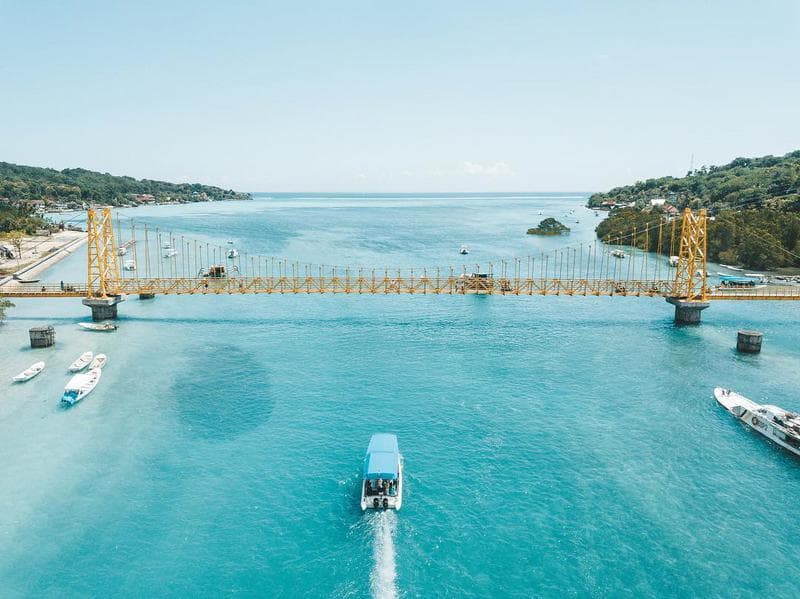
| Telatak and the Yellow Bridge | 10–15 min | About 3.5 km by scooter or truck across the south of the island. Rocky Fast Cruise docks at Telatak, near the Lembongan end of the bridge. |
| Sanur Harbour | 45–60 min | A 30–40 minute fast boat to Jungutbatu or Mushroom Bay, about IDR 150,000–300,000 one way (checked Oct 2026), then the ride across the island. Check in 60–90 minutes before departure. |
| Bali airport (DPS) | 2.5–3.5 hours | 30–60 minutes by car to Sanur Harbour, check-in, the crossing and the ride to the south-west coast. If you land after about 2 pm, sleep in Sanur and cross in the morning. |
| Seminyak, Canggu or Ubud | 2.5–4 hours | 30–90 minutes by car to Sanur Harbour depending on traffic, then the boat. Many operators sell fares with a shared hotel pickup. |
| Nusa Penida (Toyapakeh) | 25–40 min | A 10–15 minute local boat to Lembongan, about IDR 60,000 per person each way (checked Oct 2026), then a scooter or truck to the south-west. |
Getting around Devil’s Tear
There is no Grab or Gojek on Nusa Lembongan and virtually no cars. Most visitors ride a rented scooter, about IDR 80,000–150,000 a day, and leave it near the ticket post on Jalan Sandy Bay, a few minutes’ walk from the rocks. Open-backed truck taxis cost about IDR 100,000–150,000 from Jungutbatu, a lift on the back of a local’s scooter about IDR 70,000 from Jungutbatu, and open-sided buggies rent from about IDR 800,000 for five hours (checked Oct 2026). Some cliff-top hotels and beach clubs send a truck for guests coming to eat.
The lanes from Jungutbatu climb over a steep little hill with blind corners, loose sand and concrete in poor repair, and they are hard going in the dark. If you stay for sunset, ride back slowly or book a truck in advance. Walking works well from Mushroom Bay, Dream Beach and the cliff hotels.
At the site itself the ground is sharp, uneven coral limestone with holes that drop straight to the sea, and it is slippery wherever the spray lands. Wear shoes with grip, not flip-flops, keep children by the hand, and give the edge more room than feels necessary. There is no shade on the shelf, so carry water at midday.
Know Before You Go
Devil’s Tear tips that save time and trouble.
- 01Stay behind the rope and never turn your back on the sea for a photo. The waves that killed visitors here struck people standing near the edge for photos.
- 02Do not climb down toward the water to retrieve anything. If someone falls in, shout for help and throw something that floats rather than jumping after them.
- 03Carry a card: the IDR 25,000 site ticket and Klungkung’s area fee for foreigners are cashless (checked Oct 2026).
- 04The area fee, IDR 25,000 per adult and IDR 15,000 per child aged 4–13, is separate from the site ticket and from Bali’s IDR 150,000 tourist levy.
- 05Put your phone in a waterproof pouch. The spray carries far beyond the rope on big days, and salt is hard on cameras.
- 06Wear closed shoes or sturdy sandals. The limestone is sharp enough to cut feet, and parts of it stay wet all day.
- 07Day-trippers should plan around the boats: the last departures to Sanur leave around 4:30–5 pm, before the best light.
- 08Do not swim at Devil’s Tear, and swim at Dream Beach or Sandy Bay only when the sea is calm. Mushroom Bay is the island’s calm-water beach.
- 09If you stay for sunset, start back before full dark; the lanes are narrow and steep.
FAQ
Devil’s Tear questions, answered.
Is Devil’s Tear dangerous?
Yes, if you ignore the rope. Waves surge over the low shelf without warning. Between March 2018 and January 2020 at least five visitors were swept or knocked off the rocks and died or were never found, and in September 2019 two passengers drowned when a wave overturned a tour boat off the point. A rope barrier went up in 2019 and accidents have since fallen. Stay behind it, face the sea and keep children close.
How much is the Devil’s Tear entrance fee?
About IDR 25,000 per adult and IDR 15,000 per child (checked Oct 2026). Devil’s Tear became one of seven ticketed sites in the Nusa islands on 1 September 2026, and everyone pays, Indonesians included. Payment is cashless, so bring a card. Foreign visitors also owe Klungkung’s area fee for Lembongan and Ceningan, which is separate.
What is the best time to visit Devil’s Tear?
Late afternoon on a day with a decent swell, ideally around high tide. That gives the biggest spray, rainbows in the low sun and the sunset afterwards. The swell is usually strongest from May to October. Expect a crowd from about 4:30 pm; for fewer people, come in the early morning and accept smaller waves and flatter light.
What time is sunset at Devil’s Tear?
Between about 6:05 pm and 6:45 pm, depending on the month. It is earliest in late May and June, about 6:15 pm in mid-October, and latest in late January and early February. The sun sets behind Bali across the Badung Strait. Arrive an hour before to see the spray in good light, and leave the rocks soon after, before dark.
Which tide is best for Devil’s Tear?
Around high tide, when the waves reach the shelf with the most force, but swell size matters more than the tide. On a small swell at low tide the blowholes may barely work. Remember that the conditions that make the best spray are also the most dangerous, so stay further back on big days.
Can you swim at Devil’s Tear?
No. There is no beach or safe entry, the surge and backwash are violent, and rescuers have struggled to reach people in the water here. Swim at Mushroom Bay, the island’s sheltered beach, or at the mangrove beach near high tide. Dream Beach and Sandy Bay next door are for strong swimmers on calm days only.
Can you swim at Dream Beach on Nusa Lembongan?
Only if you are a strong swimmer and the sea is calm. The surf dumps hard on the sand and rips run along the shore, worst at the eastern end, so go in at the western end or not at all. When the waves are up, stay on the sand or use a resort pool. Mushroom Bay is the calm alternative.
How far is Dream Beach from Devil’s Tear?
About 600 m, or eight minutes on foot. Dream Beach lies just east of the headland and Sandy Bay just north of it, also about 600 m away by the lane. Many people combine all three in one late afternoon, ending with sunset at the Devil’s Tear point or the Sandy Bay beach club.
How do you get to Devil’s Tear?
Take a fast boat from Sanur Harbour to Nusa Lembongan, 30 to 40 minutes, then ride about 3.5 km from Jungutbatu or 1.7 km from Mushroom Bay to the south-west coast. A scooter takes 5 to 15 minutes; truck taxis and buggies are the alternatives, since there is no Grab or Gojek. From Mushroom Bay you can also walk in 20 to 25 minutes.
Can you see Devil’s Tear on a day trip from Bali?
Yes. Take a morning boat from Sanur, rent a scooter or join an island tour, and you can see Devil’s Tear, Dream Beach and the Yellow Bridge in a day. The catch is the timing: the last boats back leave around 4:30 to 5 pm, so you miss the sunset and the best light. One night on the island is better.
Is Devil’s Tear worth visiting?
Yes. On a big swell it is the most dramatic sight on Lembongan, it is easy to reach and the ticket is cheap, and with Dream Beach and Sandy Bay beside it you can fill a whole late afternoon. It disappoints on flat days and at midday, when the light is harsh and the tour groups are in. Check the swell first.
How long do you need at Devil’s Tear?
Thirty minutes to an hour for the blowholes and photos. Add an hour or more if you also walk to Dream Beach and Sandy Bay and stay for sunset. Allow 10 to 15 minutes each way from Jungutbatu, more if you are waiting for a truck taxi after dark.
Nearby
Where to go after Devil’s Tear.
Places close by that fit into the same trip, with honest travel times.
About 600 m, 8 min on foot
Dream Beach
White sand, resort cafés and pools right next door; swim only on calm days and away from the eastern end.
About 600 m, 8 min on foot
Sandy Bay (Sunset Beach)
A small west-facing cove with a beach club open 7 am to 11 pm and a sea cave at low tide.
20–25 min on foot or 5 min by scooter
Sunset Point and Mushroom Bay
The cliff path to a viewpoint over the strait, then the island’s calmest swimming beach.
20–25 min by scooter (5 km)
Blue Lagoon, Nusa Ceningan
A deep blue cove below low cliffs across the Yellow Bridge; free to see, but there are no barriers.
45–60 min by local boat and road
Crystal Bay, Nusa Penida
Penida’s best-known snorkeling bay, also a regular stop on snorkel trips from Lembongan.
Visitor guide1–1.5 hours by local boat and road
Kelingking Beach, Nusa Penida
The T-Rex headland and its steep cliff path, on a day trip from Lembongan.
Visitor guide
More in Nusa Lembongan
Plan the rest of your time in Nusa Lembongan.
Read Next
More Devil’s Tear guides.
How we researched this
Sources and fact checks.
Prices, opening hours, show times and travel times in this Devil’s Tear guide were checked against official sites, government tourism pages and recent reporting on 16 October 2026. Where sources disagreed, we give the official figure and say so. Rankings are our editorial judgment, set out in our editorial policy.
We re-check the guide at least every three months and whenever we hear about a change. Spotted something out of date? Tell us.
Show all 28 sources ↓Hide sources ↑
- dispar.klungkungkab.go.id/wp-content/uploads/2023/02/surat_89359_400.14.4…
- balipost.com/news/2026/09/11/580985/Retribusi-Pariwisata-Klu…
- balipost.com/news/2026/08/18/575011/Berlaku-Per-1-September,…
- detik.com/bali/berita/d-8614076/pungutan-retribusi-rp-25-…
- bali.live/p/from-12-august-nusa-penida-will-charge-entry-…
- bali.live/p/jams-of-cars-and-people-a-new-tourist-fee-sys…
- whatsnewindonesia.com/bali/feature/nusa-penida-goes-fully-cashless-en…
- detik.com/bali/wisata/d-7094634/devils-tears-lembongan-wa…
- thejakartapost.com/news/2018/06/11/chinese-tourist-dies-after-fall…
- asiatimes.com/2018/06/tourist-dies-taking-selfie-near-bali-af…
- coconuts.co/bali/news/viral-video-shows-australian-tourist-…
- nusabali.com/berita/37537/kecelakaan-turis-perburuk-citra-pa…
- balipost.com/news/2019/05/07/74770/Devil-Tear-Kembali-Makan-…
- coconuts.co/bali/news/chinese-tourist-dies-after-being-swep…
- news.detik.com/berita/d-4708082/2-turis-yang-tewas-di-devils-t…
- travel.kompas.com/read/2019/09/17/153030727/bahaya-mengintai-dari…
- thebalisun.com/another-tourist-dies-after-falling-into-ocean-a…
- en.wikivoyage.org/wiki/Nusa_Lembongan%20(Devil%E2%80%99s%20Tear,%…
- sandybaylembongan.com
- surf-forecast.com/breaks/Shipwrecks
- finnsbeachclub.com/guides/devils-tears-nusa-lembongan-bali
- api.sunrise-sunset.org/%20(sunset%20times%20for%20-8.6907,%20115.4300,…
- nominatim.openstreetmap.org/ui/search.html
- photon.komoot.io/%20(OSM%20nodes%20for%20the%20blowhole,%20ticke…
- routing.openstreetmap.de/%20(road%20and%20foot%20distances%20from%20Jung…
- thebaliguideline.com/blog/best-full-guide-to-lembongan
- thebaliguideline.com/blog/best-beaches-in-bali
- thebaliguideline.com/blog/best-beach-clubs-in-bali